Back
Tax Advantages of Running an Automated Coffee Business in Canada
CCA, GST/HST credits, and key deductions for smart coffee kiosks explained simply.
Understanding the tax advantages available in Canada can significantly improve the profitability and cash flow of your automated coffee business. In 2026, the Canadian tax system offers several beneficial provisions for small business owners operating in the unattended retail space, particularly those using capital equipment like smart coffee kiosks.
From our experience supporting investors across Canada, properly structuring your business and leveraging available tax incentives can reduce your effective tax burden and accelerate your return on investment. This guide outlines the key tax benefits, compliance requirements, and optimization strategies you should know.
Capital Cost Allowance (CCA) and Equipment Depreciation
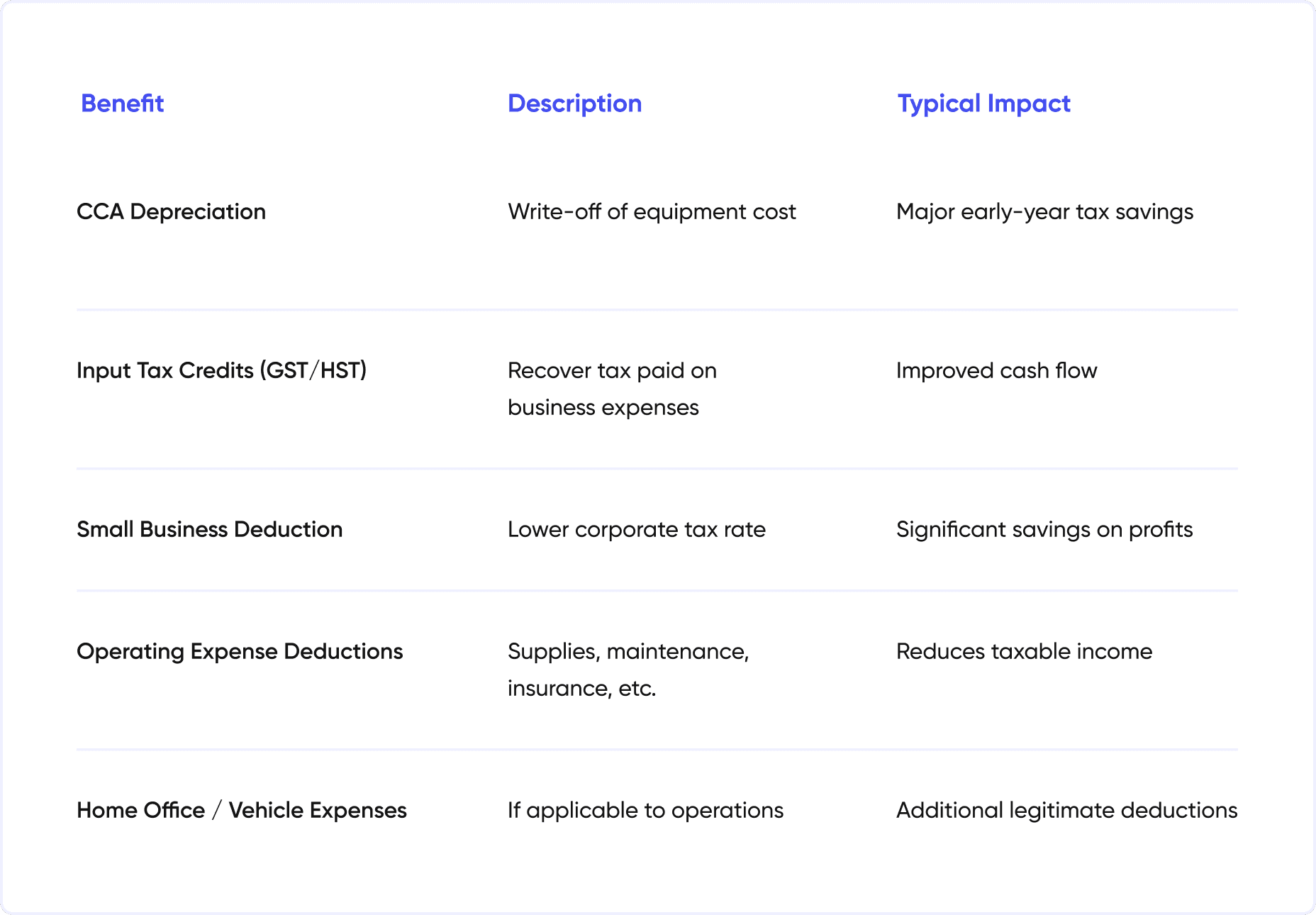
One of the strongest tax advantages for automated coffee businesses is the ability to claim Capital Cost Allowance (CCA) on your equipment.
How it works:
Smart coffee machines typically fall under CCA Class 50 (55% declining balance) or Class 8 (20% declining balance), depending on classification.
In the year of acquisition, you can claim up to 50% of the cost under the half-year rule.
This allows you to write off a significant portion of your equipment cost against business income in the early years.
For a $17,000 machine, a healthy CCA claim in the first few years can create substantial tax savings, improving cash flow during the critical payback period.
GST/HST Registration and Input Tax Credits
Once your annual revenue exceeds $30,000, you must register for GST/HST. While this adds a compliance step, it also allows you to claim Input Tax Credits (ITCs) on most business expenses, including:
Equipment purchases
Supplies (beans, cups, syrups)
Maintenance and servicing costs
Marketing and professional fees
For most automated coffee businesses, the ability to recover GST/HST paid on major purchases provides a meaningful cash flow benefit, especially in the first 1–2 years.
To explore how these tax efficiencies support broader business growth, review our guide on semi-passive coffee business ideas.
Deductible Business Expenses
A wide range of operating expenses is fully deductible, helping reduce taxable income:
Daily supplies (coffee beans, cups, milk, syrups)
Maintenance, cleaning, and servicing costs
Remote monitoring and software subscriptions
Insurance, marketing, and professional fees
Vehicle expenses (if used for restocking multiple locations)
Home office expenses (if you manage operations from home)
Keeping detailed records and receipts is essential. Many investors we support use simple expense tracking apps integrated with their accounting software to simplify this process.
Small Business Deduction and Corporate Tax Rates
If you operate through a Canadian Controlled Private Corporation (CCPC), you may qualify for the Small Business Deduction, which lowers the corporate tax rate on the first $500,000 of active business income. In many provinces, this effective rate can be as low as 9–12%, making incorporation attractive once revenue scales.
This tax planning tool can provide significant savings as your automated coffee business grows to multiple locations.
For a broader view of scalable opportunities, explore unattended retail opportunities.
Provincial Tax Considerations
Tax rules vary by province:
British Columbia, Alberta, and Ontario have different corporate tax rates and incentives.
Some provinces offer additional credits for technology or small business investments.
Sales tax (PST in some provinces) may apply in addition to GST.
Working with a knowledgeable accountant familiar with the unattended retail sector is highly recommended to maximize provincial benefits.
To understand how low-labour models improve overall tax efficiency, see our insights on low-labour business models.
Why Touch Coffee Supports Tax Efficiency
Touch Coffee equipment is designed as a capital assets that qualify for favorable CCA treatment. At Touch Coffee, you will find detailed specifications that help with tax documentation, along with transparent performance data that supports strong business cases for financing and tax planning.
The platform is built for investors who want to maximize both operational performance and tax advantages in the Canadian market. For a forward-looking view of the unattended retail category, read our analysis of the unattended retail coffee business.
Tax Benefits Summary Table
Note: Always verify with your specific municipality as rules can vary by city.
Frequently Asked Questions
Should I operate as a sole proprietorship or corporation?
Most investors with growth plans incorporate to access the Small Business Deduction and better liability protection.
How much can I save through CCA in the first year?
Depending on the amount invested, many investors save 20–35% of the equipment cost in tax savings during the first 1–2 years.
Do I need an accountant?
Yes. A good accountant familiar with small business and equipment-based operations can save you far more than their fees through proper structuring.
Are there any tax incentives for green or tech investments?
Some provinces and federal programs offer additional credits for energy-efficient or innovative technology equipment.
Navigating licensing and legal requirements for an automated coffee business in Canada is manageable when approached systematically. With the right preparation and professional equipment, you can launch legally and focus on growth rather than compliance issues.
Understanding and leveraging the tax advantages of running an automated coffee business in Canada can meaningfully improve your net returns and cash flow. With proper planning around CCA, GST/HST credits, and business structure, investors can build a more efficient and profitable operation.