Back
Low-Labour Franchise Business Models: Why Automation is Winning
Explore low-labour franchise business models for semi-passive income. Discover how automation drives scalability, ROI, and efficiency—ideal for investors in unattended retail and smart vending trends.
In an era where operational efficiency defines success, low-labour franchise business models are gaining traction among investors seeking sustainable growth without intensive daily involvement. With the unattended retail market expanding from $1.73 billion in 2025 to $1.91 billion in 2026 at a 10.6% CAGR, and projected to reach $2.76 billion by 2035, automation is proving essential for minimizing staffing needs while maximizing returns. From our years of guiding entrepreneurs through business model selection, we've seen how these models empower owners to focus on strategy rather than oversight, particularly in sectors like food and beverage, where labor shortages persist.
Traditional franchises often require extensive teams, leading to higher costs and turnover risks, but automated alternatives flip this dynamic. By integrating smart tech, these models reduce dependency on personnel, aligning with 2026 trends where food automation grows from $12.64 billion in 2025 to $20.35 billion by 2031 at an 8.26% CAGR. For serious investors, this means opportunities in unattended retail that deliver consistent performance in high-traffic environments. We'll break down the advantages, real-world applications, and future outlook, drawing on market data and partner experiences to illustrate why automation is reshaping franchising.
Automation Franchise: Reducing Overhead Through Tech
Automation-driven business models excel by embedding technology that handles core operations, from inventory tracking to customer interactions, slashing labor requirements to near zero. In commercial spaces like offices or malls, these systems operate 24/7 with remote monitoring, ensuring uptime without on-site staff. Our partners have reported significant cost savings—up to 90% reductions in labor expenses through AI-driven efficiencies—allowing focus on expansion rather than hiring.
The intelligent vending machine market, valued at $13.39 billion in 2026 and set to reach $53.11 billion by 2034 at an 18.8% CAGR, highlights this trend. Features like predictive maintenance and cashless payments (boosting transactions by 37%) create lean operations. One entrepreneur we advised deployed units in hospitals, achieving monthly profits of CA$6,300 per machine with just 20 minutes of daily input, demonstrating how automation turns low-labour models into high-yield investments.
If you're exploring automation-driven business models for reduced overhead, review Touch Coffee's tech-forward approach.
Minimal Staff Requirements in Modern Franchises
Minimal staff models prioritize systems over people, using apps and IoT for oversight and eliminating the need for full teams. This is particularly valuable in 2026, as employment in franchise-based businesses grows by 2.4% to over 9 million jobs, yet shortages persist in low-wage sectors. Investors benefit from lower payroll—often 10-20% of revenue versus 30-50% in staffed operations—freeing capital for growth.
Micro markets, generating 101% higher spend per transaction than traditional vending, exemplify this. Our experience shows partners succeeding with unattended setups in gyms, where tech manages everything from stock alerts to payments, yielding 15-40% annual ROI. A university placement we supported ran smoothly with zero employees, proving minimal staff enhances viability in competitive markets.
Considering minimal staff business models? Discover Touch Coffee's streamlined operations.
Scalable Franchise Opportunities in Unattended Retail
SScalable business models in unattended retail allow easy replication across locations, using centralized tech for multi-unit management. Starting with one site in a metro like Toronto, owners can expand to Vancouver or Calgary, achieving 20-25% net returns without scaling labor proportionally.
The U.S. unattended retail market heads toward $30 billion by 2028, driven by formats like smart stores with 4x vending volume. Partners we've mentored grew from single to three units in a year, tripling profits through app-based oversight. This scalability suits investors diversifying portfolios in growing sectors.
To build scalable income, inquire about Touch Coffee's expansion model.
Passive Operations: Hands-Off Management Success
Passive operations enable semi-absentee ownership, with automation managing daily tasks via remote tools. In 2026, as labor trends favor AI (reducing costs by 25%), these models offer flexibility for executives or multi-business owners.
Food robotics, growing from $3.5 billion in 2026 to $13.2 billion by 2035 at 15.7% CAGR, supports this. A mall setup we facilitated generated CA$9,000 monthly with passive monitoring, showcasing hands-off success.
If passive operations fit your lifestyle, connect with Touch Coffee for details.
Low Labor Models: Economic Advantages
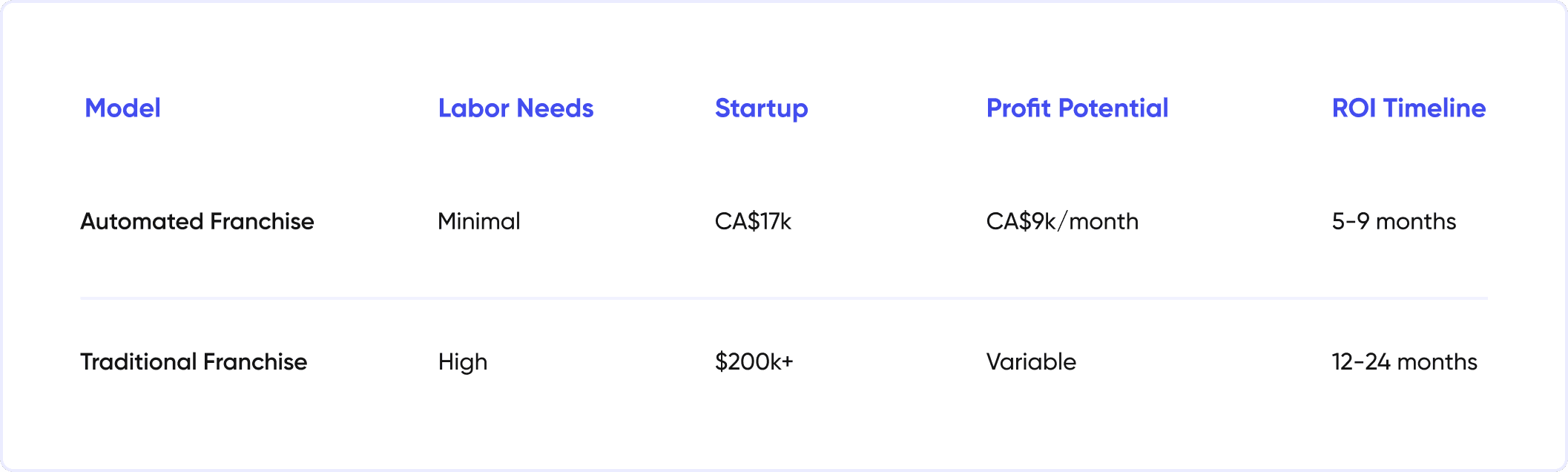
Low labor models cut expenses while boosting margins, with automation handling 90% of tasks. Startups at CA$17,000 yield 38.7% cash-on-cash returns for financed investments.
Portfolio ROIs reach 45-70% in services, as seen in our advised expansions.
Automated Franchises: Tech-Driven Future
Automated franchises use IoT for efficiency, with markets like smart vending at $17.7 billion in 2026.
Unattended Retail: Market Expansion
Unattended retail offers placement flexibility, growing to $30 billion in the U.S. by 2028.
Model Comparison
Why Touch Coffee Leads in Low-Labour Models
Under "Unisson Groupe", Touch Coffee provides a turnkey system with Smart Bar models. Explore Touch Coffee for specs, testimonials from Yummy Market, and 2025 awards.
Frequently Asked Questions
What defines low-labour models?
Tech handles operations, yielding 15-40% ROI.
How do they compare to traditional?
Lower costs, higher margins.
Experience needed?
No support included.