Back

Licensing and Legal Requirements for Starting an Automated Coffee Business in Canada
Learn how to assess foot traffic, demographics, competition, and lease terms to secure a profitable location for your automated coffee business.
Starting an automated coffee business in Canada is relatively straightforward compared to traditional foodservice models, but proper licensing and compliance are essential for legal operation and long-term success. In 2026, regulations will remain primarily handled at the municipal and provincial levels, with requirements varying significantly depending on your province and the type of locations you target.
From our experience supporting investors across Canada, understanding these requirements early helps avoid delays and ensures a smooth launch. This guide outlines the key licensing and legal steps you need to take when starting an automated coffee business in Canada.
Business Registration and General Licenses
Every automated coffee business in Canada must begin with proper business registration.
Key Steps:
Register your business name (sole proprietorship, partnership, or corporation) through your provincial registry.
Obtain a federal Business Number from the Canada Revenue Agency (CRA) for tax purposes.
Secure a general municipal business license from the city or town where your machines will be placed.
Most municipalities require a business license for vending or unattended retail operations. The cost is usually modest (a few hundred dollars per year) and is typically issued per operator rather than per machine.
Health Permits and Food Safety Compliance
Since your machines dispense beverages (and potentially other food items), you will likely need health-related approvals.
Provincial Variations:
In British Columbia, you need a Health Operating Permit from the regional health authority (e.g., Vancouver Coastal Health or Fraser Health).
In Ontario, public health units issue food premises permits or vending approvals.
Alberta and other provinces have similar local health requirements.
For sealed, pre-packaged products or automated beverage systems with proper temperature control and sanitation features, requirements are generally less stringent than for full-service restaurants. However, machines must meet basic food safety standards, and regular cleaning logs are often required.
To explore how these systems fit into low-labour operations, see our insights on low-labour business models.
Provincial and Municipal Requirements
Licensing is not uniform across Canada — each province and municipality has its own rules:
British Columbia: Business license + Health Operating Permit. Some cities have specific vending bylaws.
Ontario: Municipal business license + potential public health unit approval.
Alberta & Quebec: Generally simpler for sealed or automated beverage systems, but still require local business registration.
Always check with the specific municipality where you plan to place machines, as some cities require a separate vending permit.
For practical placement strategies that consider local regulations, see our guide on best locations for starting a smart coffee bar.
Tax and CRA Requirements
Register for GST/HST if your annual revenue exceeds $30,000.
Collect and remit sales tax on all transactions.
Maintain proper records for income tax purposes.
The CRA treats automated retail similarly to other small businesses, so standard bookkeeping and reporting rules apply.
To understand how these businesses scale efficiently, review our guide on semi-passive coffee business ideas.
Why Touch Coffee Simplifies Compliance
Touch Coffee designs its systems with Canadian regulations in mind. At Touch Coffee, you will find equipment that meets CSA and other safety standards, along with clear guidance on common licensing pathways and operational best practices.
The platform provides support to help investors navigate local requirements efficiently while focusing on growth. For a forward-looking view of the unattended retail category, read our analysis of the unattended retail coffee business.
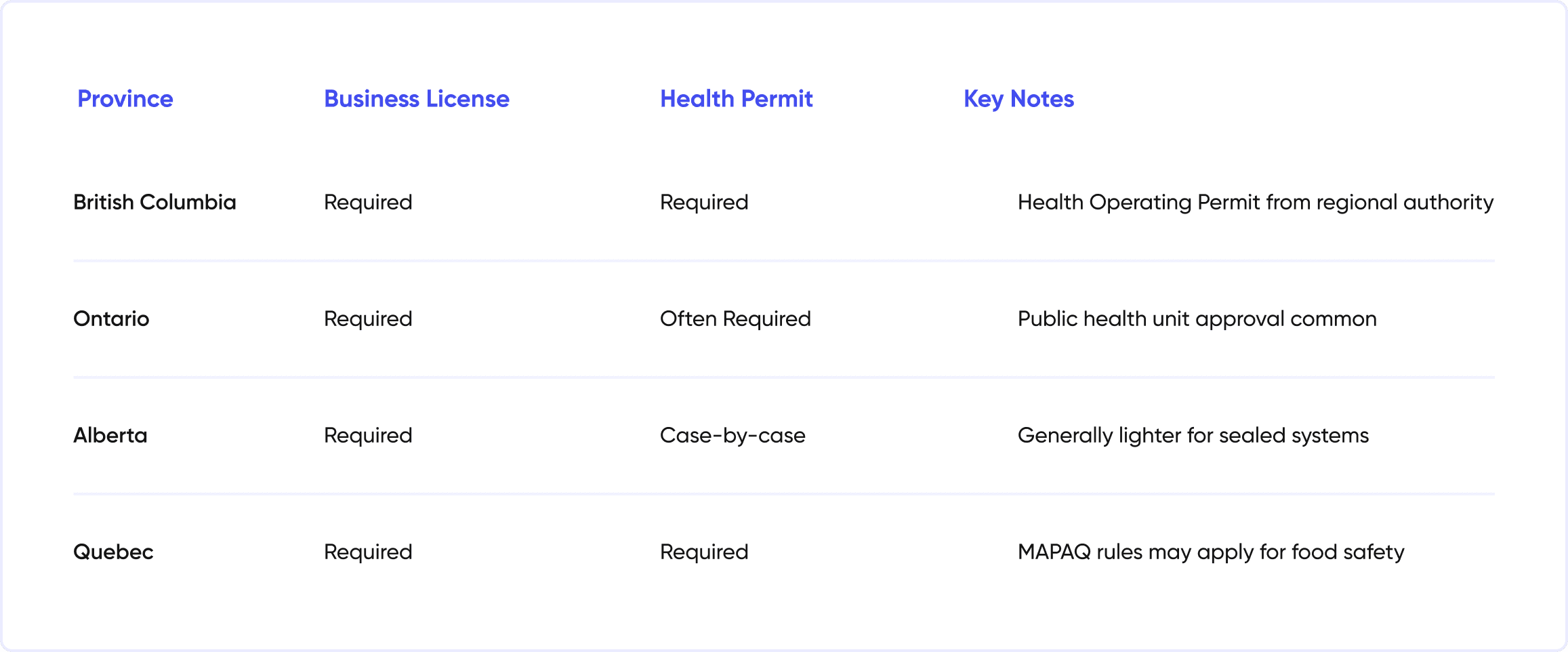
Note: Always verify with your specific municipality as rules can vary by city.
Frequently Asked Questions
Do I need a separate license for each machine?
Usually not. Most provinces issue one business license per operator/company, though some cities may require per-machine registration or decals.
How long does the licensing process take?
Typically 2–6 weeks, depending on the province and municipality. Starting early is recommended.
Are health inspections required?
For beverage systems, inspections are usually less frequent than for full restaurants, but maintaining proper cleaning logs is important.
Can I operate across multiple provinces?
Yes, but you will need to register and comply with requirements in each province where you place machines.
Navigating licensing and legal requirements for an automated coffee business in Canada is manageable when approached systematically. With the right preparation and professional equipment, you can launch legally and focus on growth rather than compliance issues.
If you are a serious investor ready to explore this opportunity in Canada, we invite you to take the next step.