Back
Key Challenges in Automated Coffee Business (And How to Solve Them)
Explore the real challenges in the automated coffee business - machine downtime, maintenance issues, customer behavior, and tech risks - plus proven solutions for high semi-passive income.
Every promising business opportunity comes with hurdles, and the automated coffee business is no exception. In 2026, the intelligent vending and smart kiosk sector continues to grow rapidly, reaching an estimated $17.7 billion globally with an 11.6% CAGR projected through 2036. Serious investors are drawn to these low-labor opportunities for their scalability and recurring revenue potential, yet many underestimate the operational realities.
From our years of supporting partners through successful deployments, we have seen that the investors who achieve the strongest results are those who anticipate and proactively address the common challenges. This guide examines the most frequent operational risks, machine downtime issues, maintenance concerns, customer behavior patterns, and tech-related hurdles - along with practical, proven solutions that keep the business running smoothly and profitably.
Machine Downtime and Reliability Risks
One of the most immediate concerns in any automated coffee business is machine downtime. Even advanced systems can experience occasional technical glitches, sensor errors, or component wear that temporarily halt service.
In real operations, unplanned downtime typically averages 2–4% of total operating time when proper protocols are followed. The key to minimizing this risk lies in predictive maintenance. Modern systems use real-time telemetry and automated alerts that notify owners of potential issues before they escalate - for example, low bean levels, syrup depletion, or brewing temperature deviations.
Partners we have worked with report that responding to alerts within 24 hours keeps downtime below 1% in most cases. Regular preventive checks and quick-response technical support further reduce this operational risk to near-negligible levels.
To understand how these systems fit into broader low-labor strategies, see our insights on low-labour business models.
Maintenance Issues and Daily Operational Demands
Maintenance issues often worry new investors because they imagine frequent service calls or complex repairs. In reality, well-designed automated coffee systems require only 15–25 minutes of daily attention for restocking beans, cups, and syrups.
The most common maintenance tasks include:
Daily or every-other-day bean and supply replenishment
Weekly deep cleaning of the waste bin and external surfaces
Monthly filter and component checks (usually handled via app reminders)
Remote diagnostics allow most minor issues to be resolved without on-site visits. When a technician is needed, response times are typically within 24–48 hours in major markets. This structure keeps the business truly low-effort while maintaining high reliability.
For practical examples of building scalable income with minimal maintenance, review our guide on semi-passive coffee business ideas.
Customer Behavior and Adoption Challenges
Customer behavior can present an initial hurdle. Some locations experience slower uptake in the first 4–6 weeks as people get accustomed to the self-service touchscreen interface and menu options.
Common patterns we observe:
Morning rush hours see the fastest adoption
Repeat customers increase dramatically after the first two weeks
Clear signage and simple instructions accelerate acceptance
Investors who provide basic venue staff training or simple instructional stickers see a 30–40% faster ramp-up in daily volume. Once customers experience the speed and quality, loyalty follows naturally.
Tech Issues and Remote Management
Tech issues occasionally arise with connectivity, software updates, or payment processing. However, modern systems include cellular backup and automatic over-the-air updates that resolve most software-related problems without owner intervention.
Risk management strategies that work well include:
Dual connectivity (Wi-Fi + cellular)
Cloud-based backup of sales and inventory data
24/7 remote monitoring dashboards
In our experience, these safeguards reduce tech-related disruptions to less than 0.5% of operating time in properly configured setups.
To see how automation addresses broader operational challenges, explore our analysis of automated food & beverage business opportunities
Risk Management and Long-Term Stability
Effective risk management in this business centers on three pillars: location quality, preventive maintenance, and diversified placement. Investors who spread units across different venue types (universities, hospitals, offices) reduce exposure to any single market fluctuation.
Proven risk management practices include:
Regular performance reviews using app analytics
Backup inventory protocols for high-volume locations
Clear escalation procedures for technical support
When these systems are followed, the business delivers remarkably stable recurring revenue with very low volatility compared to traditional staffed operations.
For a forward-looking view of the category and its resilience, read our analysis of the unattended retail coffee business.
Why Touch Coffee Minimizes These Challenges
Touch Coffee has engineered its smart coffee kiosk systems to address the most common challenges head-on. At Touch Coffee you will find transparent details on the Standard and Premium models, built-in remote diagnostics, predictive maintenance alerts, and full operational support designed to keep downtime low and performance high.
The platform emphasizes commercial-grade reliability, simple daily routines, and responsive technical assistance - all tailored for investors who want a genuinely low-maintenance opportunity.
Comparison: Common Challenges vs Proven Solutions
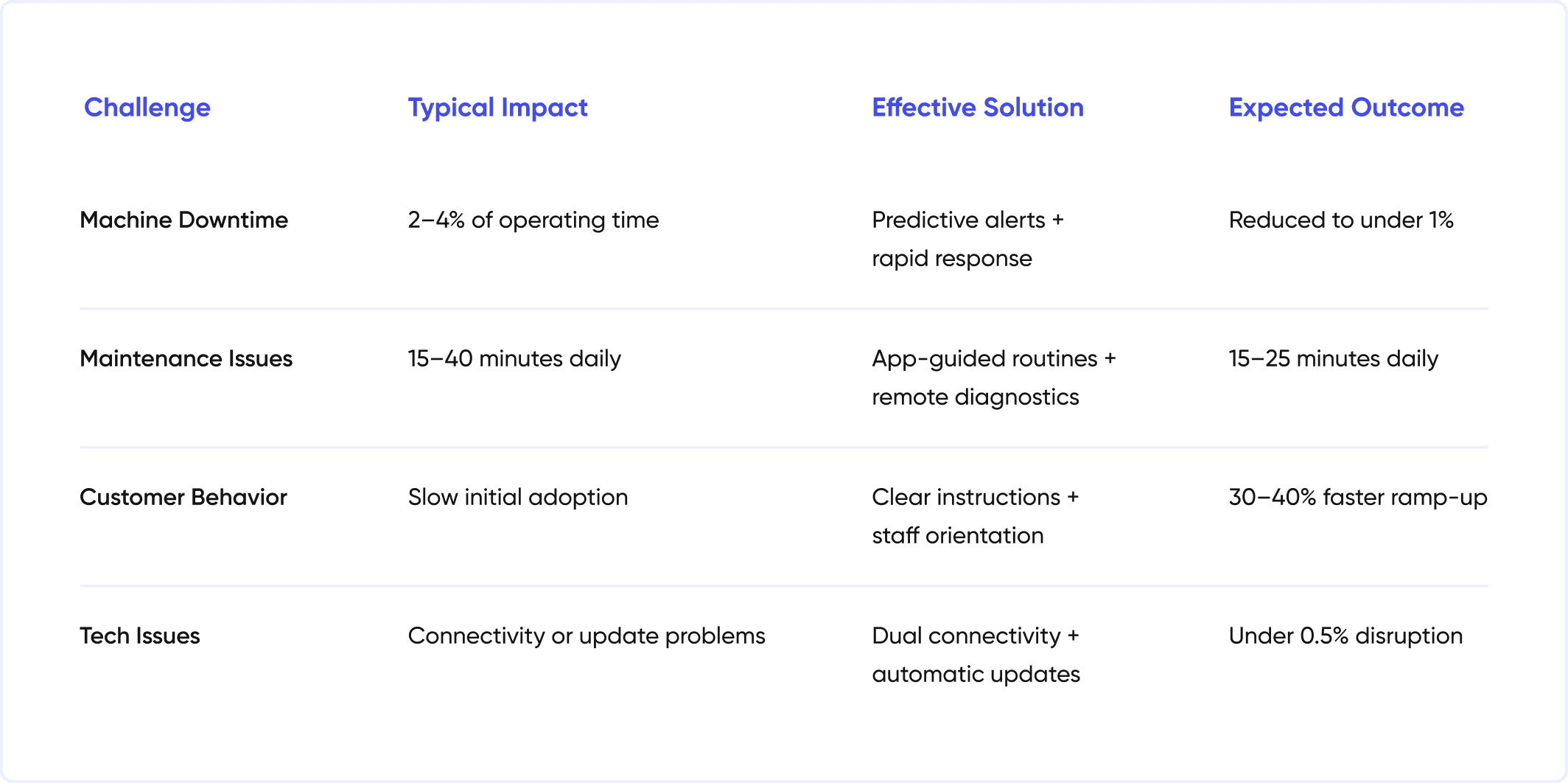
This table illustrates how proactive management turns potential obstacles into manageable, low-impact elements of the business.
Frequently Asked Questions
How serious is machine downtime in practice?
With modern predictive systems and responsive support, downtime is typically under 1% of total operating time - far lower than most investors initially expect.
What is the biggest operational risk to plan for?
Location quality remains the top factor. Choosing venues with strong, consistent foot traffic minimizes most other risks.
Can these challenges be managed without full-time involvement?
Yes. Remote monitoring and structured maintenance protocols allow most investors to handle everything in under 30 minutes per day per location.
Are these issues significantly different from traditional vending?
Modern automated systems are far more reliable due to advanced diagnostics and self-cleaning features, making them considerably easier to manage than older vending models.