Back

How to Build a Multi-Unit Automated Coffee Bar Business
A practical guide to reinvestment, expansion timing, and portfolio growth.
Most automated coffee bar owners start with one unit. The investors who build real wealth from this model are the ones who treat that first unit as proof of concept, and reinvest deliberately into a second, third, and fourth. Multi-location growth is not unique to this industry: research on service-business expansion shows roughly two-thirds of service businesses plan to expand to additional locations within three years, and businesses that successfully add a second location see a meaningful revenue multiplier over single-location operators, according to a 2026 industry analysis of multi-location business performance.
The same discipline that makes a Touch Coffee Smart Bar work as a single unit- low overhead, remote monitoring, minimal daily time input- is exactly what makes it scale well across multiple locations. This article covers how to think about reinvestment, when to add a second unit, and what to track as you move from one location to a portfolio.
Why a Coffee Bar Portfolio Scales Differently Than Most Small Businesses
A second location is where most small business expansions run into trouble. Industry data on multi-location expansion shows a meaningful share of expansions struggle within their first two years, typically because a second physical location multiplies the same problems that made the first one hard: staffing, lease negotiation, inventory management, and hands-on daily oversight, now doubled.
An automated coffee bar largely sidesteps this problem. There is no staff to hire or manage at a second site, no lease to negotiate in the traditional sense, units are placed inside partner venues under revenue-share or placement agreements rather than leased retail space, and the ~20 minutes of daily management time per unit does not compound the way in-person retail management does. A second unit adds monitoring, not a second full-time operational burden. This is the structural reason unit economics that work for one Smart Bar tend to replicate cleanly across additional ones.
The Reinvestment Model: Funding Unit Two From Unit One
The most capital-efficient way to build a portfolio is to let the first unit fund the second, rather than raising or financing all units simultaneously. This mirrors standard reinvestment discipline in any cash-flowing small business, reinvest a defined share of operating profit into growth capital before treating it as personal income.
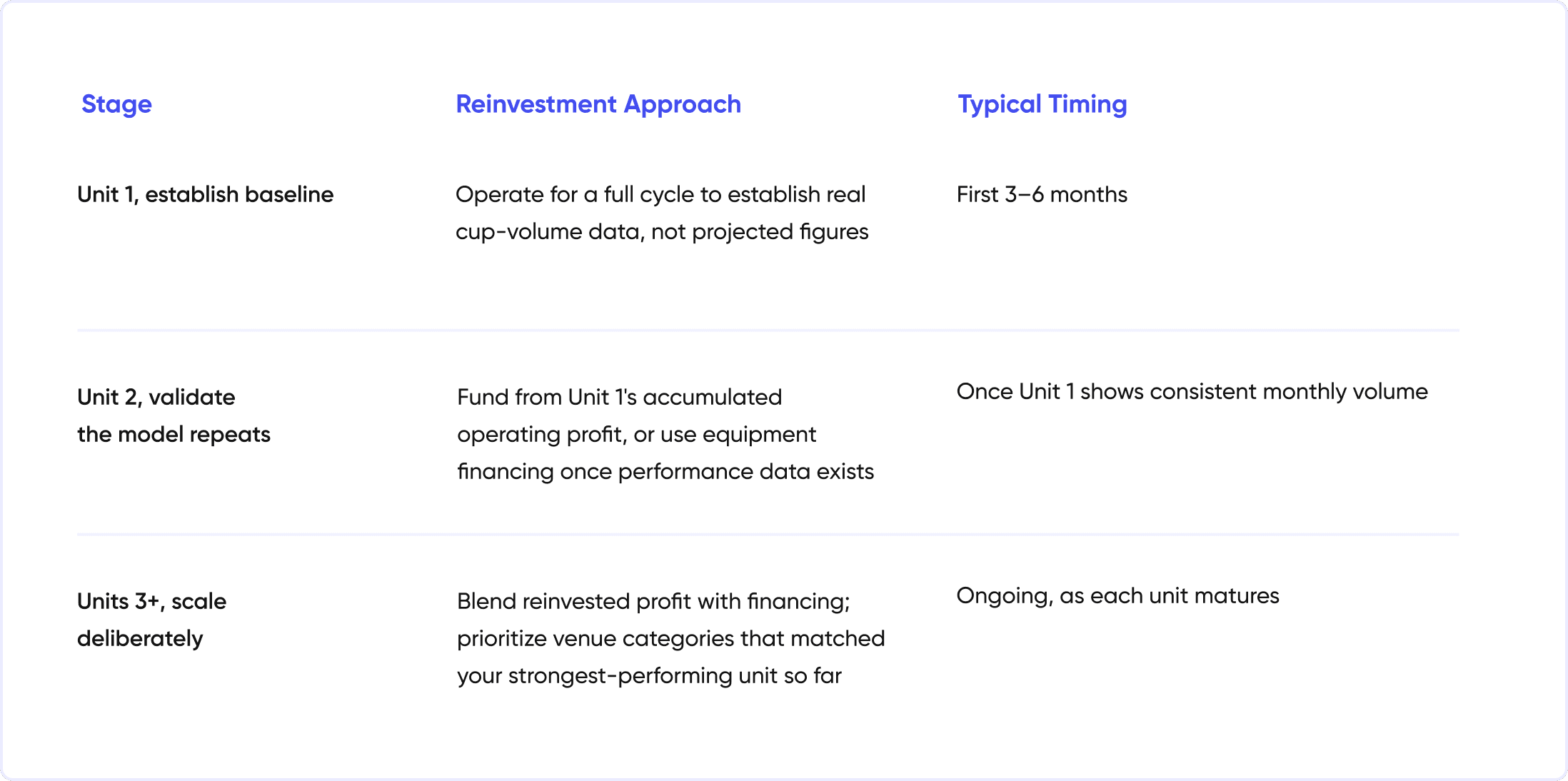
If you have not yet financed a first unit, our guide to financing your first automated coffee bar covers the specific CSBFP and BDC-backed options structured for the CA$17,000 entry cost, the same financing paths apply to funding additional units once you have operating history to show a lender.
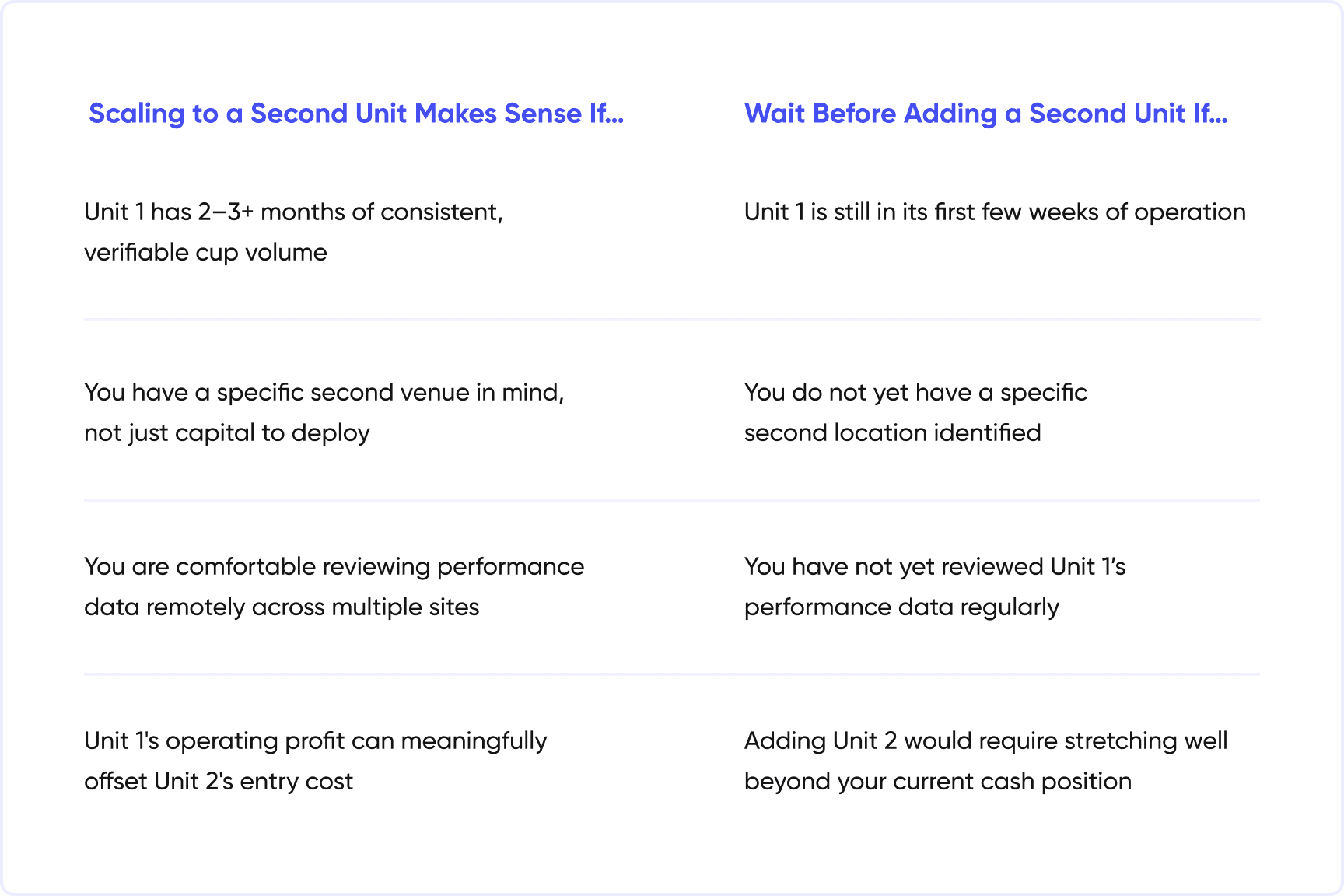
When to Add a Second Unit, A Practical Framework
Adding a second unit before the first is proven is the most common mistake in early-stage multi-unit growth. Use these signals rather than a fixed timeline.
Consistent monthly cup volume: Your first unit has shown at least 2–3 consecutive months of stable or growing volume, not a single strong month
Positive operating profit after all costs: Ingredient cost, royalty fee, and any venue revenue-share are already netted out, you are looking at real profit, not gross sales
A second venue lead you can evaluate on its own merits: Not a venue chosen simply because it is available, but one that matches the traffic pattern that worked for Unit 1
Bandwidth to monitor two dashboards, not two job sites: Confirm you are comfortable with remote monitoring across multiple units before assuming it scales effortlessly
What to Track as You Scale: The Portfolio-Level KPIs
This comparison can be done using third-party monitoring tools such as Nayax and/or other SaaS portal, where operators can review available performance data across their locations. Touch Coffee provides basic guidance for using these third-party platforms, while their features and functionality are managed by the respective providers.
Revenue per unit, compared across the portfolio: Identifies which venue types are consistently outperforming, so future placements can target similar traffic patterns
Cups per day trend, by location: A declining trend at any single unit is worth investigating early, before it affects the reinvestment plan
Uptime percentage: Directly affects revenue at scale, a maintenance issue at one unit is a smaller problem than the same issue across three
Portfolio-level cash flow, not just per-unit profit: The reinvestment decision for Unit 4 should be based on total portfolio cash position, not any single unit in isolation
Diversifying Venue Types as You Scale
A portfolio built entirely around one venue category, all campus placements, or all gyms, carries concentrated risk if that category faces a slow season or policy change. Investors building toward three or more units generally benefit from spreading placements across a mix of venue types with different traffic drivers: a campus or institutional location with predictable term-time traffic, alongside a venue with more consistent year-round demand such as a gym, hospital, or workplace. Our comparison of unattended retail business models across venue types is a useful reference when mapping out which combination fits your target portfolio.
Is Multi-Unit Growth the Right Move for You Right Now?
Start Building Your Portfolio the Right Way
The investors who scale successfully treat each additional unit as its own decision, backed by real data from the units already running, not a blanket assumption that what worked once will automatically work three more times. The model's low-labor structure makes multi-unit ownership genuinely achievable, but the discipline of validating before reinvesting is what separates a resilient portfolio from an overextended one.
If you already own a unit and are evaluating whether it is time to add a second, or want to talk through how to structure a multi-unit growth plan from the start, contact the Touch Coffee team directly. We can walk through what your current performance data suggests about readiness for expansion, and what venue types make sense for your next placement.
Ready to talk through your growth plan? Start the conversation with Touch Coffee today and get a clear picture of what scaling looks like for your specific situation.