Back

Why Hotels Are a Strong Location for an Automated Coffee Bar
How hotel traffic, guest demand, and low staffing requirements create a strong placement opportunity.
A hotel lobby is one of the most consistent-traffic environments an unattended retail operator can place a unit in, guests, visitors, and staff pass through it multiple times a day, at nearly every hour. Canada's hotel sector counted roughly 8,289 properties and more than 460,000 rooms generating close to CA$22 billion in annual revenue in the most recent full-year data available, according to a 2026 hotel industry data report, and the sector's construction pipeline remains near record highs heading into 2026 and 2027, according to Lodging Econometrics.
If you are evaluating where to place a Touch Coffee Smart Bar this article covers the actual demand data behind a hotel placement, what a unit can realistically earn against traditional hotel coffee service, and the specific steps to approach a property, not general information about the hospitality industry.
Why Hotel Guests Are a Strong Coffee-Buying Audience
Coffee has moved from a background amenity to a measurable driver of guest satisfaction. A 2025 American Hotel & Lodging Association report found that 72% of guests cite in-room and on-property beverage quality as a significant factor in their overall satisfaction score, directly tied to repeat bookings and review ratings. Separately, Cornell University's School of Hotel Administration found that properties offering branded specialty coffee saw a 15% higher average rating on major review platforms compared to properties with generic coffee offerings.
This demand is not limited to overnight guests. A hotel lobby sees a mix of check-in and check-out traffic, conference and event attendees, walk-in visitors, and on-duty staff, several distinct audiences passing through the same high-visibility space throughout the day. Industry amenity guides for 2026 confirm a coffee or tea station remains one of the amenities travellers expect as standard across nearly every hotel tier, alongside Wi-Fi and parking.
What a Coffee Vending Machine Actually Earns in a Hotel, And How It Compares
Most hotels currently handle coffee through one of two low-margin approaches: complimentary in-room packets, or a staffed lobby café that carries significant labour overhead. An unattended premium coffee bar sits in a different category entirely, and the comparison is useful context for any investor evaluating this venue type.
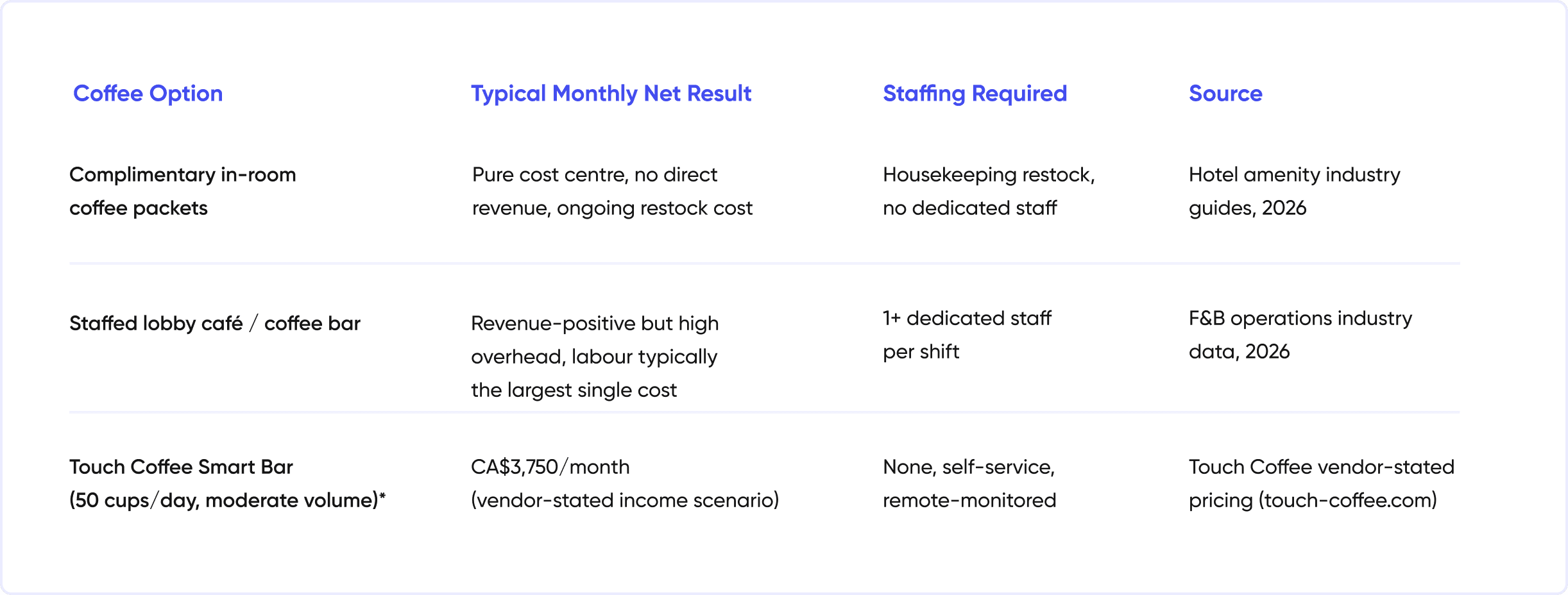
*Figure reflects Touch Coffee's own published income scenario at 50 cups/day, 1 unit, an aspirational example, not a guaranteed outcome, per Touch Coffee's Earnings & Disclaimer. See our full revenue breakdown by location type for the complete scenario table and underlying assumptions.
The structural difference is what makes a hotel placement attractive: a Smart Bar removes the labour cost that makes a staffed café expensive to run, while still producing a premium product guests are already conditioned to expect and pay for. If you want to see exactly what unit economics look like before approaching a property, review the current Smart Bar pricing directly.
Where a Unit Performs Best Inside a Hotel
Placement inside the property affects performance meaningfully, and different hotel zones serve different guest moments.
Main lobby, near check-in/check-out: Highest visibility, captures arriving guests, departing guests, and anyone waiting at the desk
Near the elevator bank or main guest corridor: Strong for repeat daily traffic from in-house guests moving between rooms and common areas
Adjacent to conference or event space: Particularly strong for properties with regular business and event bookings, where attendees look for coffee between sessions
Avoid: Placements tucked behind the front desk or in back-of-house corridors, visibility from the main guest path is what drives usage, not proximity to staff
How to Secure a Hotel Placement, Step by Step
Hotels operate with a clear decision structure, and the approach differs slightly from a gym or campus placement. Based on standard B2B venue placement practice for unattended retail, here is the actual process.
Step 1: Identify the Right Property Type
Mid-scale and upper-midscale properties, the largest and fastest-growing segment in Canada's current hotel pipeline, are typically the strongest fit, since they want a premium guest touchpoint without the overhead of a full-service café. Properties without an existing staffed lobby coffee program are the clearest opportunity.
Step 2: Identify the Right Decision-Maker
Approach the Food & Beverage manager or General Manager directly, not the front desk. F&B is typically the department that owns any amenity with a revenue or guest-experience component, and is the fastest path to a decision.
Step 3: Lead With the Guest Experience Angle, Then the Numbers
Hotel decision-makers respond to guest satisfaction data first, cite the review-score and satisfaction research above, then follow with the commercial structure: no staffing cost, no water line required, and a placement that requires only standard 120V power. Our guide to venue negotiation and placement agreements covers how to structure this conversation and what revenue-share terms are typically reasonable for both sides.
Step 4: Confirm Installation Requirements During a Property Walkthrough
Confirm available lobby or corridor space and electrical access on-site. Hotels generally move faster than institutional venues like hospitals or campuses on approval, since a single F&B manager or GM can often authorize the placement without a multi-stakeholder committee process.
Step 5: Monitor Performance From Day One
Once installed, use the partner dashboard to track early cup volume against occupancy patterns, the same data that will inform whether this property is a strong candidate for a second unit or expansion to other locations within the same hotel group.
Is a Hotel the Right Placement for Your Next Unit?
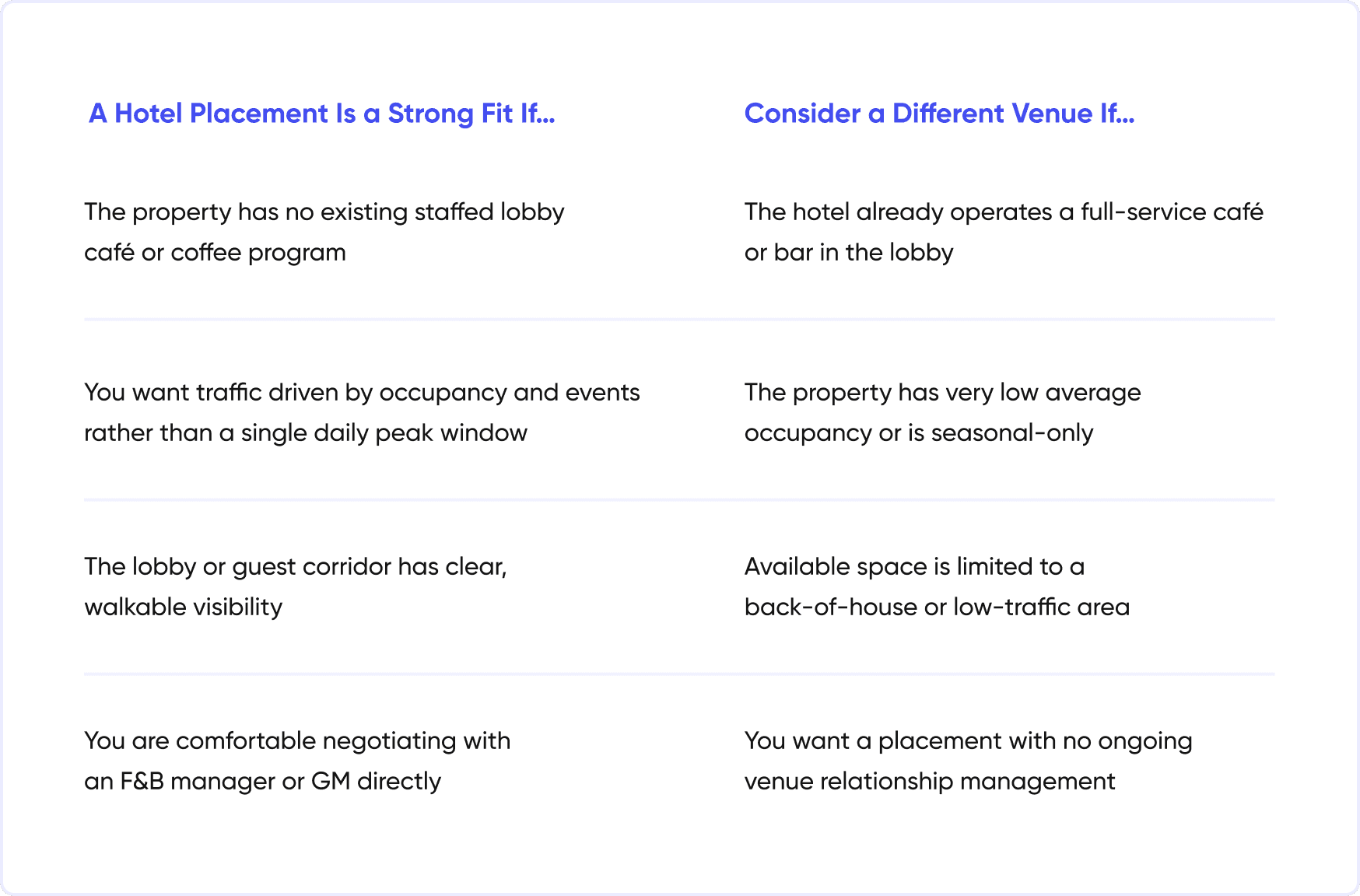
For investors weighing a hotel placement against other high-traffic venue categories, our breakdown of the best locations for starting a smart coffee bar compares hotels against gyms, campuses, and offices side by side. And if you are still working out the broader financial case for a first unit, our guide to semi-passive coffee business ideas for serious investors is a useful starting point before narrowing in on a specific venue type.
Ready to Place a Unit in a Hotel?
Hotels combine consistent multi-audience traffic, a guest base already conditioned to expect quality coffee, and a decision structure that can move faster than institutional venues, a strong combination for an automated coffee bar placement.
If you have already identified a target property, or want help evaluating whether a specific hotel is a strong candidate, contact the Touch Coffee team directly. We can walk through the placement proposal, financing options for the CA$17,000 entry cost, and realistic volume expectations for your specific property type.
Have a hotel in mind already? Start the conversation with Touch Coffee today and get the specific numbers for that property before your next guest checks in.