Back

Venue Negotiation & Placement Agreements: What Terms to Expect
Negotiating a coffee vending machine placement? Learn what terms typically appear in a venue agreement, what’s negotiable, and what protects both sides.
The machine is the asset. The venue agreement is what makes that asset worth anything.
Every article in the Touch Coffee network that discusses gyms, hotels, campuses, or hospitals eventually points to the same next question: once a venue says yes, what does the actual agreement look like? This is the piece that answers that question directly, what terms typically appear in a placement agreement, what’s usually negotiable, and what protects both the investor and the venue over the life of the placement.
Why the Agreement Matters More Than the Handshake
A verbal yes from a facilities manager gets a machine installed. A written agreement is what protects the revenue that machine generates for years afterward. As covered in our guide to exit planning, a documented, transferable venue agreement is frequently the single most valuable component of a coffee bar business when it comes time to sell, sometimes more valuable than the machine itself. That value doesn’t appear automatically; it comes from specific terms negotiated and put in writing at the outset.
A B2B placement agreement for an automated coffee bar is structurally different from a retail lease. There’s no square footage rent, no build-out obligation, no long-term real estate commitment. What exists instead is a simpler commercial arrangement: the investor supplies, installs, and maintains the machine, the venue provides space and power, and the two sides agree on term, revenue treatment, and responsibilities.
The Core Terms Every Placement Agreement Should Cover
Based on standard B2B venue-placement practice for unattended retail, here are the components that should appear in any placement agreement, regardless of venue type.
Term Length and Renewal Most placement agreements run one to three years, with either an automatic renewal clause or a defined renewal process. A longer initial term with clear renewal language protects the investor’s revenue stream and, as noted above, makes the business more valuable to a future buyer. Short or ambiguous terms create uncertainty on both sides.
Revenue Treatment Some venues expect a revenue-share percentage; others accept the placement as a no-cost amenity in exchange for the convenience it offers staff, students, or guests. Both structures are common across the Touch Coffee network, gyms and campuses often accept a no-revenue-share amenity framing, while some retail and mall environments expect a percentage. This is one of the more genuinely negotiable terms and should be discussed openly rather than assumed.
Space and Utility Requirements The agreement should specify the exact location within the venue, confirmed electrical access (standard 120V power), and any restrictions on relocating the unit without prior approval. A Touch Coffee Smart Bar requires no water line, which simplifies this section considerably compared to a staffed café or full kitchen installation.
Maintenance and Responsibility The agreement should be clear that the investor, not the venue, is responsible for machine maintenance, cleaning, and restocking. Venues want this stated explicitly so there’s no ambiguity about who to call if something goes wrong, and investors want it stated explicitly so the venue doesn’t assume ownership of a responsibility that isn’t theirs.
Termination Conditions Both sides should know what happens if either party wants to end the arrangement early, notice period, removal timeline, and any costs associated with early termination. A fair termination clause protects the investor from losing a placement with no warning, and protects the venue from being locked into an arrangement that isn’t working.
Assignment and Transfer Rights This term is easy to overlook early on but matters significantly later. As detailed in our guide to exit strategy, an agreement that explicitly permits transfer to a new owner is worth meaningfully more to a future buyer than one that requires separate venue approval for every change of ownership. Negotiating assignment rights at the outset, even if a sale feels years away, is a low-cost, high-value addition to the agreement.
What’s Typically Negotiable, and What Isn’t
Investors approaching their first venue conversation often aren’t sure which terms have room to move. Based on standard placement negotiation practice:
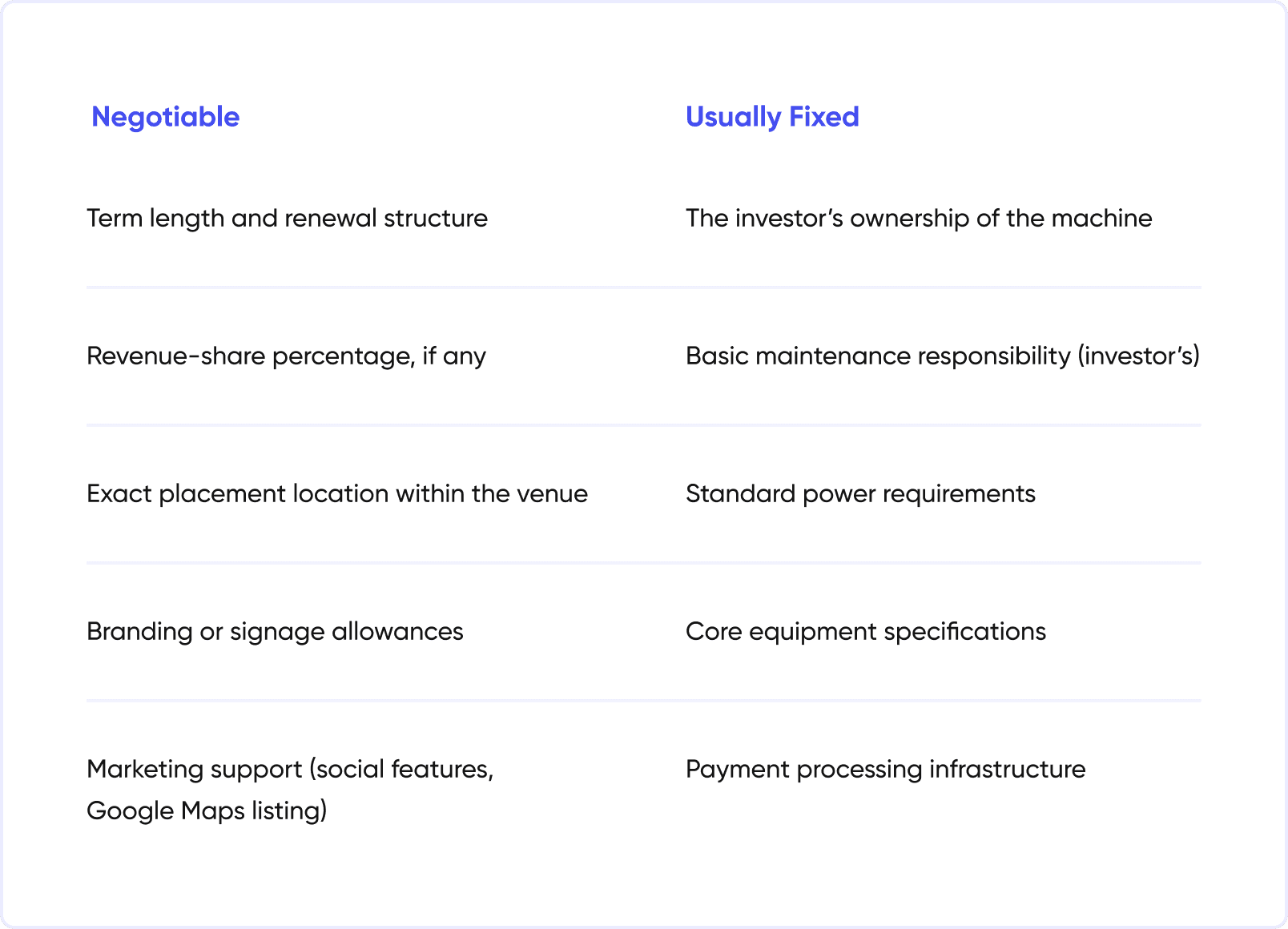
Revenue share and term length are the two terms investors most commonly negotiate, and they’re often connected: a venue asking for a revenue share may accept a longer term in exchange, while a venue offering a no-cost amenity arrangement may prefer more flexibility on term.
How the Negotiation Conversation Typically Unfolds
How the Negotiation Conversation Typically Unfolds
Every venue type, gym, hotel, hospital, campus, has a different decision-maker and pace, covered in more detail in our venue-specific guides. But the negotiation conversation itself tends to follow a consistent structure across categories:
Lead with the amenity value: what the placement does for the venue’s staff, members, students, or guests, before discussing commercial terms Present the no-cost, no-staffing framing clearly: the venue isn’t taking on a vendor relationship with ongoing obligations Bring specific numbers: the Smart Bar’s footprint, power requirements, and, where relevant, proposed revenue-share terms Address maintenance and responsibility directly, so the venue understands exactly what they are and aren’t responsible for Put the agreed terms in writing before installation, not after
Venues that move fastest tend to be ones without an existing coffee option and with a single decision-maker who can approve the placement directly. Larger institutions with multi-stakeholder approval processes, discussed in our hospital and campus placement guides, take longer but often result in longer, more stable terms once approved.
A Note on Formalizing the Agreement
None of the above is legal advice, and every investor should have a placement agreement reviewed by a lawyer before signing, particularly around termination, liability, and assignment terms. A modest legal review cost upfront is a small price relative to the protection it provides over a multi-year placement.
Get the Terms Right From the First Placement
A strong placement agreement protects the revenue you’re building from day one, and sets up the business, whether you plan to hold it for years or eventually sell, for its strongest possible position. The terms outlined above aren’t complicated, but they’re easy to skip when a venue conversation feels informal and a handshake feels sufficient.
If you’re approaching your first venue conversation, or want to review the terms of an agreement already on the table, contact the Touch Coffee team directly. We can walk through what’s typical, what’s worth negotiating, and how our partner support model helps structure these conversations from the start.
Have a venue conversation coming up? Start the conversation with Touch Coffee today and get the specifics you need before you sit down at the table.
For investors weighing a campus placement against other high-volume venue categories, our breakdown of the best locations for starting a smart coffee bar compares campuses against hospitals, malls, and offices side by side.