Back

Universities & Campuses: Why They’re the Highest-Volume Placement in the Touch Coffee Network
University and campus placements post the strongest cup-volume numbers in the Touch Coffee network. See the real data, placement strategy, and how to approach a campus.
Ask any automated coffee bar operator which venue category performs best by sheer volume, and the honest answer is not a hospital, not a mall, not an office. It’s a campus.
Across the Touch Coffee network, university and college locations average 75–95 cups per day, the highest of any venue category the company tracks. That is not a coincidence of foot traffic alone. A campus combines something few other venue types offer at the same intensity: a large, captive population that returns to the same buildings multiple times a day, on a predictable academic schedule, for months at a stretch.
This article breaks down why campuses perform the way they do, what the real numbers look like, and the specific steps to approach a university or college about a Smart Bar placement, not general commentary on student life.
Why Campus Populations Are a Strong Coffee-Buying Audience
A university or college is functionally a small city that runs on caffeine. Between early lecture blocks, library study sessions, and evening classes for part-time and mature students, campus buildings see sustained foot traffic across a longer daily window than a typical 9-to-5 office.
Coffee consumption is also embedded in campus culture in a way that’s hard to replicate elsewhere. Students studying for exams, faculty between lectures, and administrative staff working standard business hours create overlapping demand curves throughout the day rather than a single narrow peak. A library or student union building in particular tends to see coffee demand stretch from early morning through late evening.
Touch Coffee Smart Bar units are already active in real campus environments across the network, including at Ontario Tech University and Okanagan College, alongside institutional venues like Kelowna General Hospital that share a similar high-frequency, captive-audience profile.
What a Coffee Vending Machine Actually Earns on a Campus, And How It Compares
Real operational data from the Touch Coffee network puts university and college placements at the top of the venue performance table:
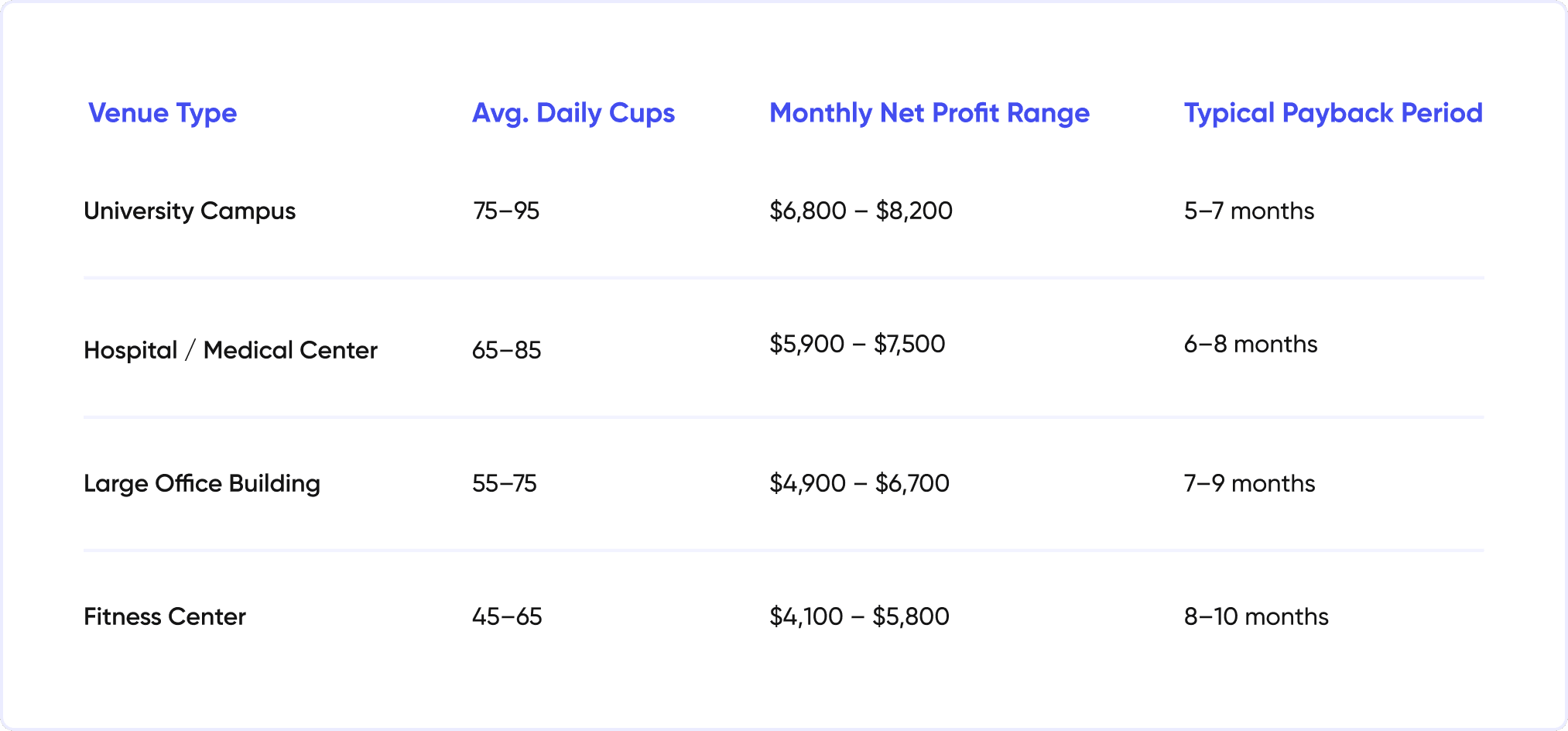
The gap between a campus placement and a moderate-traffic office is not small: moving from an office-level volume to a university-level volume can lift monthly net profit by 40–60%, according to aggregated performance data across the network. For investors comparing venue categories before committing to a placement, that difference is one of the highest-leverage decisions available.
Where a Unit Performs Best on Campus
Not every building on a campus performs equally, and placement within the institution matters as much as the institution itself.
Library entrances and study commons: Long dwell times and late-hour demand from students studying make this one of the strongest single locations on most campuses
Student union or campus centre buildings: High cross-traffic from students moving between classes, clubs, and services throughout the day
Near lecture hall clusters: Captures the between-class rush, particularly in buildings with back-to-back scheduling and limited passing time
Avoid: Isolated administrative wings or buildings with restricted public access, foot traffic alone does not guarantee volume if the building population is small
The Academic Calendar Is a Real Factor, Worth Planning For
An honest look at campus placements has to include the seasonal pattern that comes with them. Campus foot traffic drops substantially during summer months when most academic terms are not in session, and again during winter and reading-week breaks. This is a structural feature of the venue type, not a flaw in the placement.
Investors evaluating a campus unit should build this into their financial model from the outset rather than assuming flat monthly output year-round. A well-built projection accounts for reduced summer volume the same way a retail projection accounts for a holiday-season peak, as a known variable rather than a surprise.
Institutions with year-round programming, summer session courses, conference bookings, or graduate and continuing-education populations tend to see a smaller seasonal dip than undergraduate-only campuses. This is worth confirming directly with facilities staff during the approval conversation.
How to Secure a Campus Placement, Step by Step
Campus procurement moves differently than a gym or a single-location retail business, and it helps to understand the process before approaching an institution.
Step 1: Identify the Right Building, Not Just the Right Campus
A large university is really a collection of separate buildings with different traffic profiles. Target buildings with high daily footfall and no existing premium coffee option nearby, libraries, student centres, and buildings housing large lecture halls are typically the strongest candidates.
Step 2: Identify the Right Decision-Maker
Campus facilities decisions usually route through a Facilities Management office or, for auxiliary services like food and beverage, a dedicated Ancillary or Auxiliary Services department. Larger institutions may require committee-level sign-off; smaller colleges can often move faster through a single facilities contact.
Step 3: Bring the Institutional Case, Not Just the Consumer Case
Campus decision-makers respond to a framing that emphasizes student and staff amenity value at no cost or operational burden to the institution, alongside the commercial specifics: standard 120V power requirement, no water line needed, and a defined footprint of a few square feet. Our guide to venue negotiation and placement agreements covers how to structure this conversation in more detail.
Step 4: Confirm Installation Requirements During a Site Walkthrough
Confirm available space and electrical access directly with facilities staff. Larger institutions may also require a procurement or vendor-approval process before installation, worth asking about early so it doesn’t add unexpected delay.
Step 5: Monitor Performance From Day One, With the Academic Calendar in Mind
Once installed, use the partner dashboard to track cup volume against the academic term. Early data from the first full semester is what will tell you whether this campus, or this specific building, is a strong candidate for a second unit elsewhere on the same campus.
Is a Campus the Right Placement for Your Next Unit?
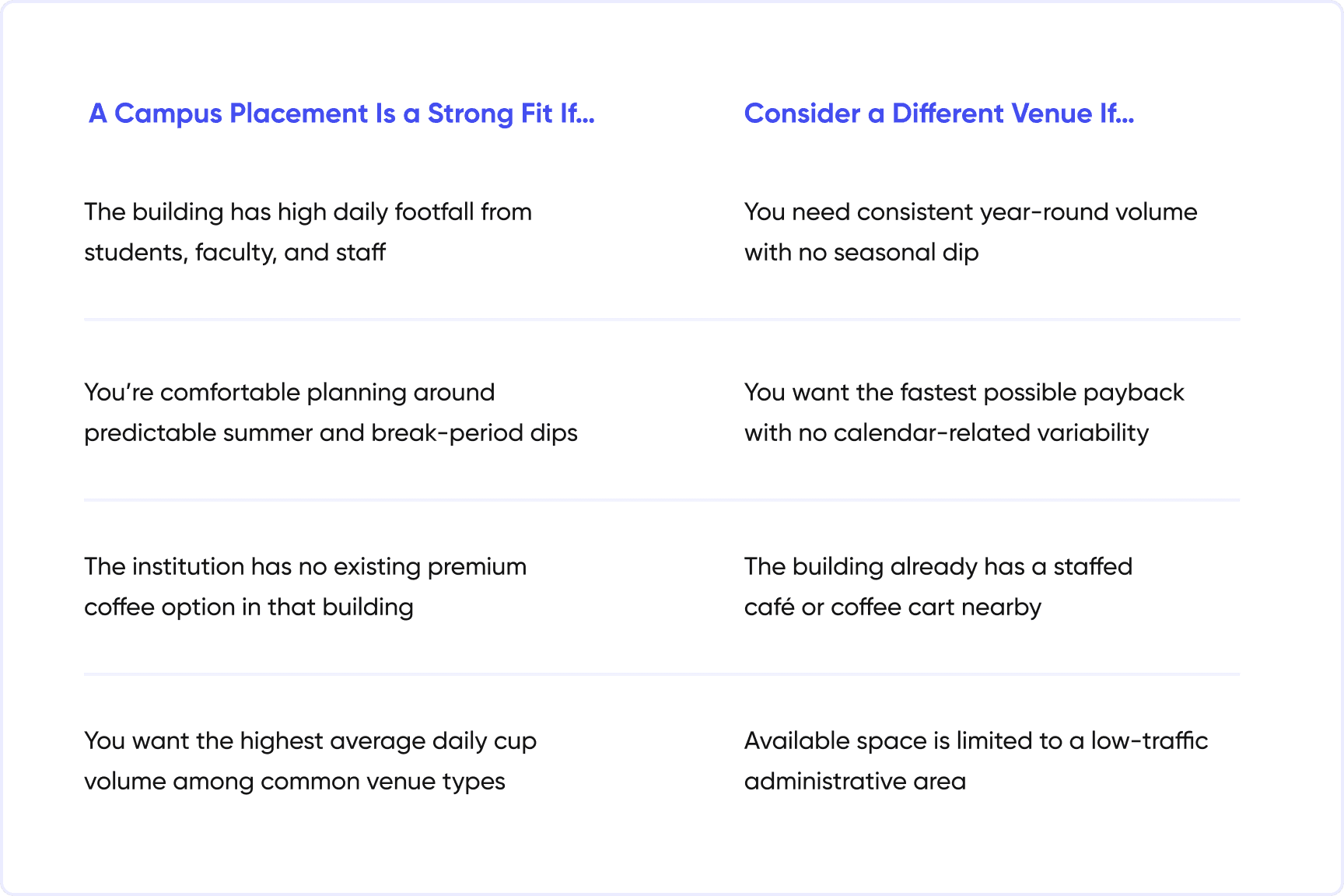
For investors weighing a campus placement against other high-volume venue categories, our breakdown of the best locations for starting a smart coffee bar compares campuses against hospitals, malls, and offices side by side.
Ready to Place a Unit on a Campus?
Universities and colleges post the strongest average cup-volume numbers of any venue type in the Touch Coffee network, a large, returning population, multiple daily peak windows, and a product category most campus food services haven’t fully brought into the automated era.
If you’ve already identified a target institution, or want help evaluating whether a specific campus building is a strong candidate, contact the Touch Coffee team directly. We can walk through the placement proposal, the CA$17,000 entry cost, and realistic volume expectations that account for the academic calendar.
Have a campus in mind already? Start the conversation with Touch Coffee today and get the specific numbers for that building before the next semester starts.