Back
How the Automated Coffee Bar Business Model Generates Predictable Profits
Learn how automated coffee bars generate predictable profits with low labor, scalability, and strong ROI.
In an era where efficiency and technology converge to redefine investment landscapes, the automated coffee bar business model emerges as a compelling option for forward-thinking entrepreneurs. Drawing from our decades of guiding partners toward sustainable growth, we've observed how this approach transforms high-traffic environments into reliable profit centers. With the global unattended retail market expanding from $1.73 billion in 2025 to $1.91 billion in 2026 at a 10.6% CAGR, models like these capitalize on consumer demand for convenience without the burdens of traditional operations.
This model isn't about daily micromanagement; it's engineered for predictability, leveraging automation to minimize variables like labor fluctuations and operational downtime. For serious investors eyeing semi-passive ventures, understanding its core components - from streamlined structures to expansion potential - reveals why it consistently delivers measurable returns. We'll break it down step by step, incorporating real-world insights and industry data to help you evaluate its fit for your portfolio.
Business Structure of Automated Coffee Bars
At its foundation, the automated coffee bar business structure prioritizes simplicity and technology integration, creating a framework that's resilient and easy to oversee. Unlike conventional franchises requiring extensive staffing, this model relies on proprietary machines equipped with features like touchscreen interfaces, remote monitoring apps, and auto-maintenance systems. In our experience supporting partners, this setup allows owners to focus on strategic decisions rather than hands-on tasks, aligning perfectly with semi-passive ownership.
Key elements include compact units designed for high-traffic placements such as offices, hospitals, and malls - spaces where foot traffic naturally drives demand. No plumbing or specialized infrastructure is needed; a standard outlet suffices, reducing setup barriers. Industry trends reinforce this: Food and beverage automation is projected to grow from $12.64 billion in 2025 to $20.35 billion by 2031, fueled by AI and robotics that address labor shortages by up to 90% in some sectors. For investors, this translates to a lean operation where the machine handles brewing, payments (via systems like Nayax), and even inventory alerts, ensuring smooth functionality with minimal intervention.
Consider a real placement in a university setting: One partner we advised reported seamless integration, with the unit operating 24/7 and requiring only occasional restocking. This structure not only lowers entry hurdles - starting around CA$17,000 - but also builds in redundancies for uptime, making it a stable foundation for long-term wealth building. If this efficient design appeals to your investment strategy, explore how Touch Coffee implements it.
Revenue Streams in the Automated Model
Diversifying revenue streams is key to the model's predictability, turning a single unit into a multifaceted income generator. Primary earnings come from per-cup sales, with premium drinks like espressos and lattes priced at CA$4 on average, but the structure allows for add-ons such as customizations or loyalty integrations via apps. In high-volume locations, this can yield 50-100 transactions daily, scaling based on foot traffic.
Beyond direct sales, ancillary streams include partnerships with venue hosts (e.g., revenue shares in malls) and data-driven upsells through connected tech. Our partners have seen success by analyzing app data to optimize menus, boosting average ticket values. Market data supports this: Smart vending innovations drive 101% higher spend per transaction compared to traditional models, emphasizing how automation enhances customer engagement without added labor.
From our vantage point, one entrepreneur expanded revenue by placing units in complementary sites like gyms, where quick-access drinks align with user routines. This multi-stream approach mitigates risks, ensuring steady cash flow even in variable markets. Ready to map out your revenue potential? Calculate it with Touch Coffee's tools
Managing Operating Costs for Maximum Efficiency
Effective cost management is where the automated model truly shines, keeping expenses low to preserve margins. Core operating costs include supplies (beans, cups, syrups) at roughly CA$1 per serving, royalties (typically 5%), and minimal maintenance - often just 20 minutes daily. No salaries for staff eliminates a major expense line, which can account for 30-50% in traditional setups.
Energy and tech support are streamlined: Units run on 120V power with remote diagnostics, cutting repair visits. In our collaborations, partners have reduced overhead by bulk purchasing supplies and using predictive analytics to avoid overstocking, aligning with broader trends where automation slashes costs by 25%. Vending industry averages show machines netting $200-800 monthly after costs, but optimized automated bars often exceed this through efficiency.
A partner in a hospital location shared how app-based monitoring prevented downtime, saving thousands annually. By focusing on these controllable costs, investors maintain healthy margins - typically 10-30% - fostering a model that's as cost-effective as it is profitable. To see cost breakdowns in action, visit Touch Coffee for detailed insights.
The Profit Model: Breaking Down the Numbers
Here's a sample breakdown:
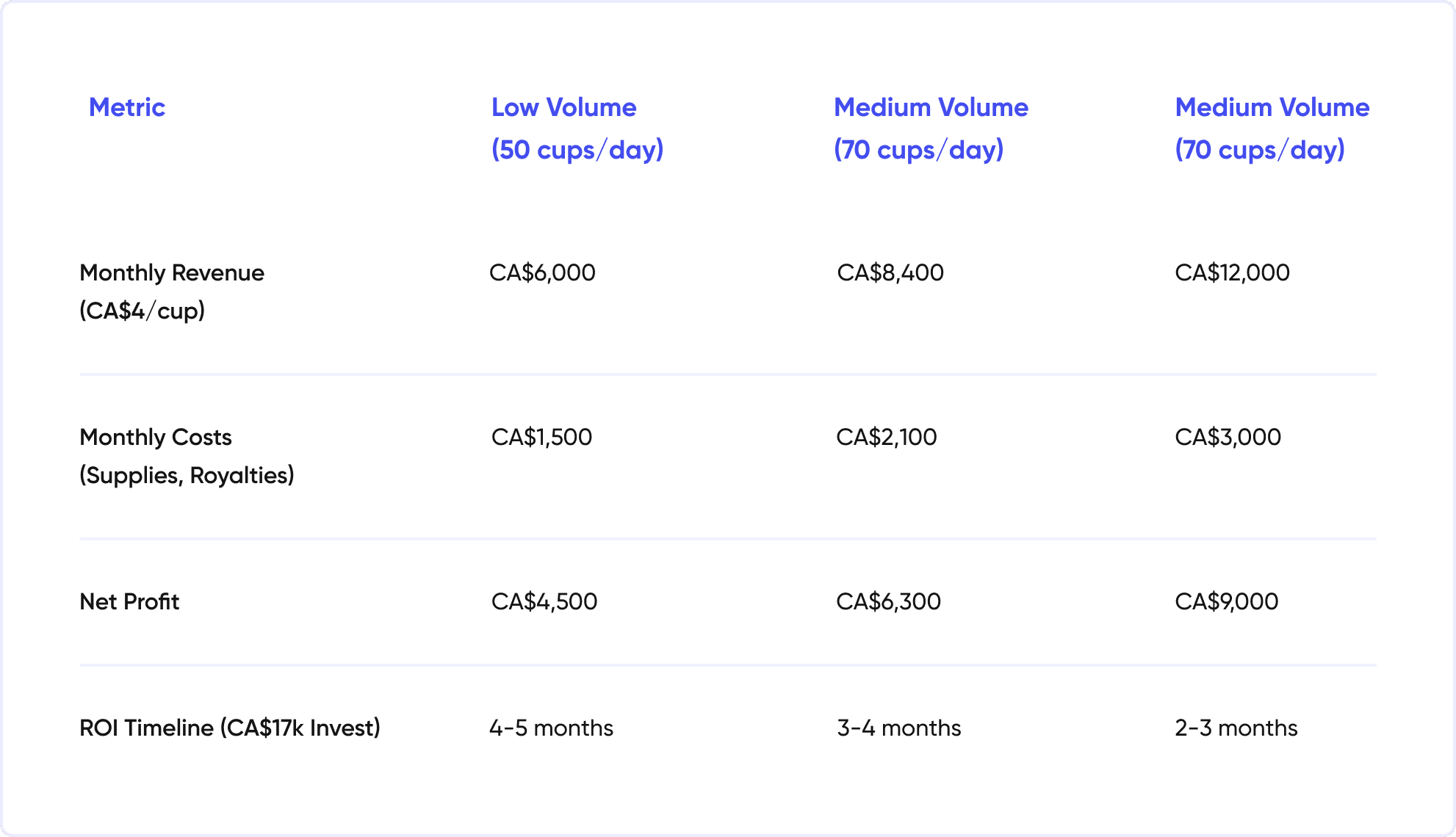
These figures draw from partner experiences and align with vending trends, where well-placed units achieve 40-50% margins. In a Toronto mall setup we supported, consistent traffic led to exceeding projections, underscoring the model's reliability. For a personalized profit assessment, inquire at Touch Coffee.
Scalability: Growing Your Automated Coffee Investment
Scalability sets this model apart, allowing investors to expand from one unit to a network without proportional effort increases. Start in a single metro like Vancouver, then replicate in Calgary or Edmonton using the same app dashboard for oversight. Industry growth supports this: The vending market hits $23.9 billion in 2026, with micro-markets generating 4x the volume of traditional vending.
Our partners often scale by leveraging location data to identify high-potential sites, achieving 20-25% net returns in semi-passive setups. One investor grew to three units in a year, tripling profits through strategic placements. This repeatability, backed by platform support, makes it ideal for portfolio diversification.
Why Touch Coffee Exemplifies the Automated Coffee Bar Model
As a flagship example under "Unisson Groupe", Touch Coffee delivers a turnkey automated coffee business platform focused on unattended retail success. At Touch Coffee, you'll find comprehensive details on models like the Smart Bar Premium (200 cups/day capacity with advanced features) and Standard, plus testimonials from placements at Focus College and Yummy Market. Recognized with the 2025 Best Coffee Vending Technology award, it provides the ecosystem - machines, training, and support - for predictable profits without retail coffee sales.
If scaling a low-labor venture excites you, connect with Touch Coffee today to discuss opportunities.
Frequently Asked Questions
How does this model ensure semi-passive operation?
Automation handles daily functions, with owners investing minimal time via remote tools, as seen in successful automated business models requiring 10–15 hours weekly.
What differentiates it from traditional vending?
Premium tech and scalability yield higher ROI, with margins up to 50% versus standard 10-30%.
Is experience required?
No - robust support systems make it accessible, similar to high-performing structured business models compared to independent businesses.
In summary, the automated coffee bar business model offers a path to predictable profits through smart design and market alignment. For investors ready to capitalize, start your journey with Touch Coffee