Back

Risks of an Automated Coffee Business: What Investors Should Know
The key operational risks, costs, and safeguards to consider before investing.
Every business carries risk, and an honest evaluation of the Touch Coffee Smart Bar opportunity- or any automated coffee bar model- should include a clear look at what can go wrong, not just what tends to go right. This article covers the operational risks documented across the broader vending and unattended retail industry, how they typically apply to an automated coffee bar specifically, and what reduces their impact in practice.
Why This Category Has a Mixed Reputation- and Why That's Worth Addressing Directly
The vending machine business has a real, documented failure pattern worth acknowledging upfront. Industry commentary from Vendingcore, an operator-focused vending industry publication, estimates that roughly 35% of new vending operators quit within their first year, most often due to unrealistic expectations about how passive the business actually is in its early stages. This figure comes from industry commentary rather than a formally audited dataset, so it should be treated as a directional signal rather than a precise statistic- but it is consistent with the general pattern described across multiple vending-industry sources: the businesses that struggle tend to be the ones where the owner underestimated the operational attention required, particularly around machine uptime and location performance.
An honest risk discussion is also, in a practical sense, part of good due diligence which is exactly the kind of research someone reading a touch coffee review or touch coffee smart bar review is typically trying to do before committing capital.
Risk 1: Machine Downtime and Its Direct Revenue Impact
Downtime is the most immediate and measurable risk in any automated retail business- a machine that is not working generates zero revenue, full stop. According to data cited by the National Automatic Merchandising Association (NAMA), machine downtime accounts for an average of 3–5% of revenue loss across the vending industry. Vending Times research further indicates that new equipment experiences roughly 40% less downtime and 30% lower maintenance costs over the first three years compared to refurbished or older equipment- a meaningful factor when evaluating any unit, including an automated coffee bar.
Common causes of downtime documented across vending industry sources include:
Mechanical component failure dispensing mechanisms, grinders, and brewing components in coffee-specific equipment
Payment system malfunctions card reader or contactless payment failures
Environmental factors- excessive heat, dust, or humidity affecting internal components over time
Power or connectivity interruptions at the venue
Running out of key ingredients between scheduled restocking visits
According to the U.S. The Department of Energy cited a maintenance benchmark reported by Daedalus Distribution, preventive maintenance costs 12–18% less than reactive repairs, and equipment run to failure without preventive service can cost up to 10 times more to repair than equipment on a regular maintenance schedule. This is one of the clearest, most consistently cited findings across the sources reviewed for this article- proactive maintenance materially changes both downtime frequency and cost.
Risk 2: Revenue Concentration in a Single Location
Unlike a diversified investment, a single automated coffee bar unit generates revenue from exactly one physical location. If that location's foot traffic declines- due to a venue closure, a change in the institution's policies, seasonal fluctuation, or a lost lease- the unit's revenue is directly and immediately affected, with no other revenue source to offset the loss.
This risk is structural, not hypothetical, and it applies to any single-unit automated retail business regardless of the manufacturer. It is the primary reason experienced operators- as discussed in our companion article on building a multi-unit portfolio - tend to diversify across multiple venues over time rather than concentrating their entire investment in a single placement.
Risk 3: Overestimating Cup Volume Before Placement
A common pattern across vending industry sources- reflected in GrowthGrid's 2026 vending business guide and Foodline Machinery's 2026 vending industry overview- is that new operators tend to overestimate how much revenue a location will generate before they have real operating data from that specific venue. Foot traffic estimates, demographic assumptions, and comparisons to other locations are useful starting points, but actual cup volume can differ meaningfully from projections until a location has been running for several weeks or months.
This is why revenue figures should generally be treated as scenario ranges rather than fixed expectations- a point covered in more depth in our coffee bar vs. rental property comparison, which models conservative, moderate, and strong volume scenarios rather than a single projected number.
Risk 4: Seasonal and Venue-Specific Demand Swings
Certain venue categories have predictable seasonal patterns that affect revenue. Campus locations, for example, see substantially reduced traffic during summer months when academic terms are not in session- a pattern discussed in our guide to campus placements. Office locations can see similar dips around holiday periods or shifts to remote work arrangements. This risk is manageable through awareness and planning- annual revenue projections should account for these known cycles rather than assuming flat monthly output- but it is a real factor that affects cash flow timing.
Risk 5: Vandalism, Theft, and Liability Exposure
Unattended equipment in a public or semi-public space carries some exposure to vandalism or theft, particularly in less secure or lower-visibility locations. According to CaseDIYMachine's 2026 vending risk overview, general liability insurance for a vending-style unit typically runs roughly $40–$60 per month, with the exact cost depending on location type- indoor, secured locations are generally less expensive to insure than outdoor or higher-traffic public locations. This is a modest, predictable cost relative to the protection it provides and is a standard part of operating any unattended retail equipment responsibly.
How Remote Monitoring Technology Changes the Risk Picture
The risks above are largely industry-wide and apply to unattended retail equipment generally- they are not unique to any single brand. What has measurably changed the risk profile of modern automated retail, according to Vending Market Watch research, is remote monitoring technology: operators who review performance data weekly identify and resolve issues roughly 40% faster than those who do not.
A unit with real-time dashboard visibility into sales, inventory, and machine status- the kind of monitoring described in our overview of Smart Bar performance tracking - allows an owner to catch a payment system fault, a low-stock warning, or an unusual performance pattern before it becomes a multi-day outage. According to Touch Coffee, this is the specific function the partner dashboard is designed to serve; as with any vendor-specific capability, prospective investors should confirm current dashboard features directly with the Touch Coffee team rather than relying solely on this description.
Budgeting for Risk: A Practical Reserve Planning Example
Several vending-industry sources, including VendingCore's 2026 profitability guide, suggest reserving roughly 20% of projected revenue for combined ongoing costs- restocking labour, commissions or venue-related fees, payment processing, and a maintenance fund. This is an industry rule of thumb from vendor/blog commentary, not a formally audited benchmark, and actual costs will vary by unit and location- but it is a reasonable starting point for building a conservative financial model rather than assuming 100% of gross margin converts directly to take-home profit.
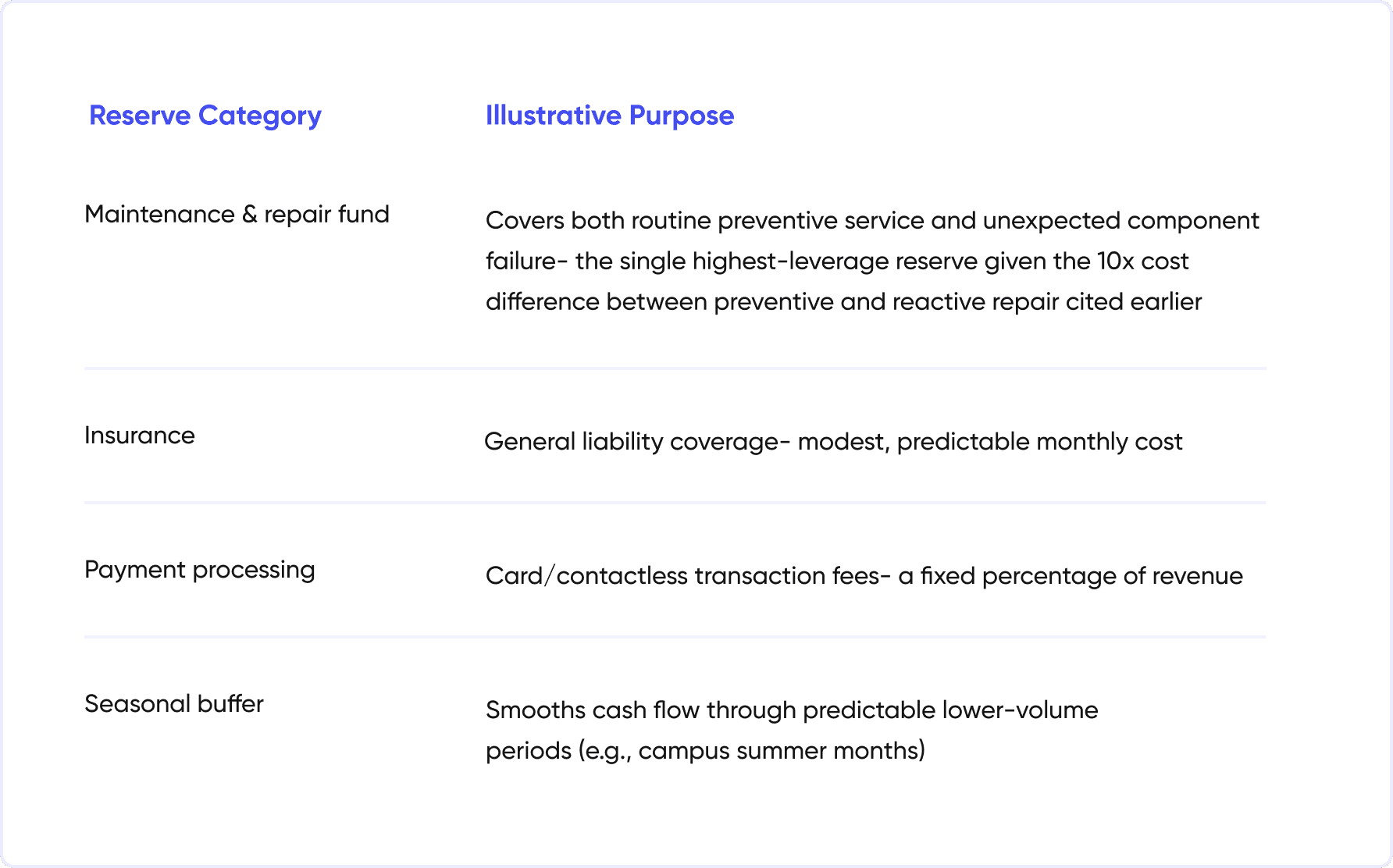
This kind of reserve planning is a general financial discipline applicable to any unattended retail investment- it is not specific to a single manufacturer or model, and each investor should build their own version based on their specific location, machine, and vendor cost structure.
Questions Worth Asking Before You Commit
Given the risks above, a thorough due-diligence process for any automated coffee bar investment- including a Touch Coffee Smart Bar- reasonably includes questions such as:
What warranty coverage applies to the equipment, and for how long?
What does the remote monitoring dashboard actually show, and how quickly are alerts typically resolved?
What is the expected response time for a technical support request?
What happens contractually if a specific venue placement ends- is relocation supported, and what does that process involve?
What ongoing fees apply beyond the initial purchase price, and how are they structured?
These are reasonable questions for any prospective investor to bring to a conversation with the Touch Coffee team or with any vendor in this category before committing capital.
An Honest Risk Picture Is Part of a Sound Investment Decision
None of the risks discussed here are unique to the automated coffee bar category, and none of them are unmanageable- but pretending they do not exist would not serve a serious investor evaluating this opportunity. Downtime, location dependency, demand variability, and ongoing operating costs are real factors that affect any unattended retail investment, and understanding them in advance is what separates informed capital from a hopeful bet.
If you are researching the vending machine business category and want a direct conversation about how these risks specifically apply to the Touch Coffee Smart Bar- including warranty terms, support response times, and the dashboard's monitoring capabilities - reach out to the Touch Coffee team. A grounded, specific answer to your due-diligence questions is a better foundation for a decision than either an overly optimistic pitch or a vague general disclaimer.
For a broader look at how these risk factors weigh against the potential return, our comparison of a coffee bar investment against a traditional rental property covers risk on both sides of that comparison in more detail.