Back

How to Write an Automated Coffee Bar Business Plan in Canada
A practical guide to market research, operations, financial projections, and funding.
A business plan for an automated coffee bar should include an executive summary, business description, market analysis, financial projections, an operations plan, and, if seeking financing, a clear funding request. Most lenders and investors expect this in roughly 5 to 15 pages for a business at this scale, according to Ownr and Startup Project's 2026 templates, concise enough to read quickly, detailed enough to show you have done the work.
That is the short version. If you are looking to start a business in Ontario, or anywhere in Canada, around a Touch Coffee Smart Bar, the sections below walk through exactly what each part of that plan should contain, using the specific numbers and structure of an automated coffee bar business as the working example throughout.
Why a CA$17,000 Business Still Needs a Written Plan
It is tempting to assume a business plan is only necessary for large ventures seeking six or seven figures in outside investment. That is not accurate for a coffee vending machine business, and for two specific reasons.
First, if you are financing the purchase through the Canada Small Business Financing Program or a BDC loan, most lenders will ask for some form of written plan and cash flow projection as part of the application, even for a modest loan amount. Second, and more important for most investors: the process of writing the plan forces you to work through assumptions, cup volume, location choice, timeline to profitability, before you commit capital, not after. According to Custom CPA's 2026 business plan guide, this is exactly why even experienced entrepreneurs write a plan even when no one is requiring one of them.
The Core Sections Every Coffee Vending Machine Business Plan Should Include
Based on standard Canadian business plan structure, confirmed across guidance from Shopify Canada, Ownr, and Custom CPA's 2026 frameworks, here is what each section should contain for an automated coffee bar business specifically.
1. Executive Summary
A one-page overview covering what the business is, the investment required, and the expected return. For a Touch Coffee Smart Bar, this typically states: entry investment (CA$17,000), the business model (automated, unattended coffee retail placed in an institutional venue), and the target outcome (a defined payback period at a stated cup-volume assumption). Investors and lenders skim first; according to Startup Project's 2026 template guide, this section should lead with your strongest, most specific points rather than general statements.
2. Business Description
What the business actually is and how it operates day to day: a self-service, automated coffee bar unit placed in a single venue (or multiple venues), generating revenue through per-cup sales with minimal daily owner involvement. This section should also state the ownership structure, sole proprietorship, incorporated business, or partnership, since that decision affects financing eligibility and, eventually, how the business would be structured for an exit down the line.
3. Market Analysis
This is where generic plans fall apart, according to Custom Accounting's 2026 investor-ready guide: vague market-share claims without evidence. A strong market analysis for a coffee vending machine business should be built bottom-up, not top-down. Rather than citing the total size of the Canadian coffee market, focus on the specific venue: daily foot traffic at your target location, existing coffee options nearby, and a realistic capture rate based on comparable placements. Our breakdown of how revenue actually performs across different venue types is a useful evidence source for this section; it gives you defensible, cited cup-volume ranges by venue category rather than invented projections.
4. Operations Plan
How the business actually runs: daily management routine (dashboard checks, restocking schedule), the venue agreement and its term, and support arrangements for maintenance. For a Touch Coffee Smart Bar, this section can reference the ~20-minute daily time commitment and remote monitoring dashboard as the operational backbone, specific, verifiable details a lender or co-investor can evaluate, rather than a vague description of "low-maintenance operations."
5. Financial Projections
The section most business plans get wrong, according to StartupOwl's 2026 financial projections guide: overly optimistic "hockey stick" curves with no visible assumptions. Every number in this section should trace back to a stated assumption, your assumed cups-per-day figure, your per-cup margin, and your estimated operating cost reserve. A defensible financial projection for a Touch Coffee Smart Bar includes:
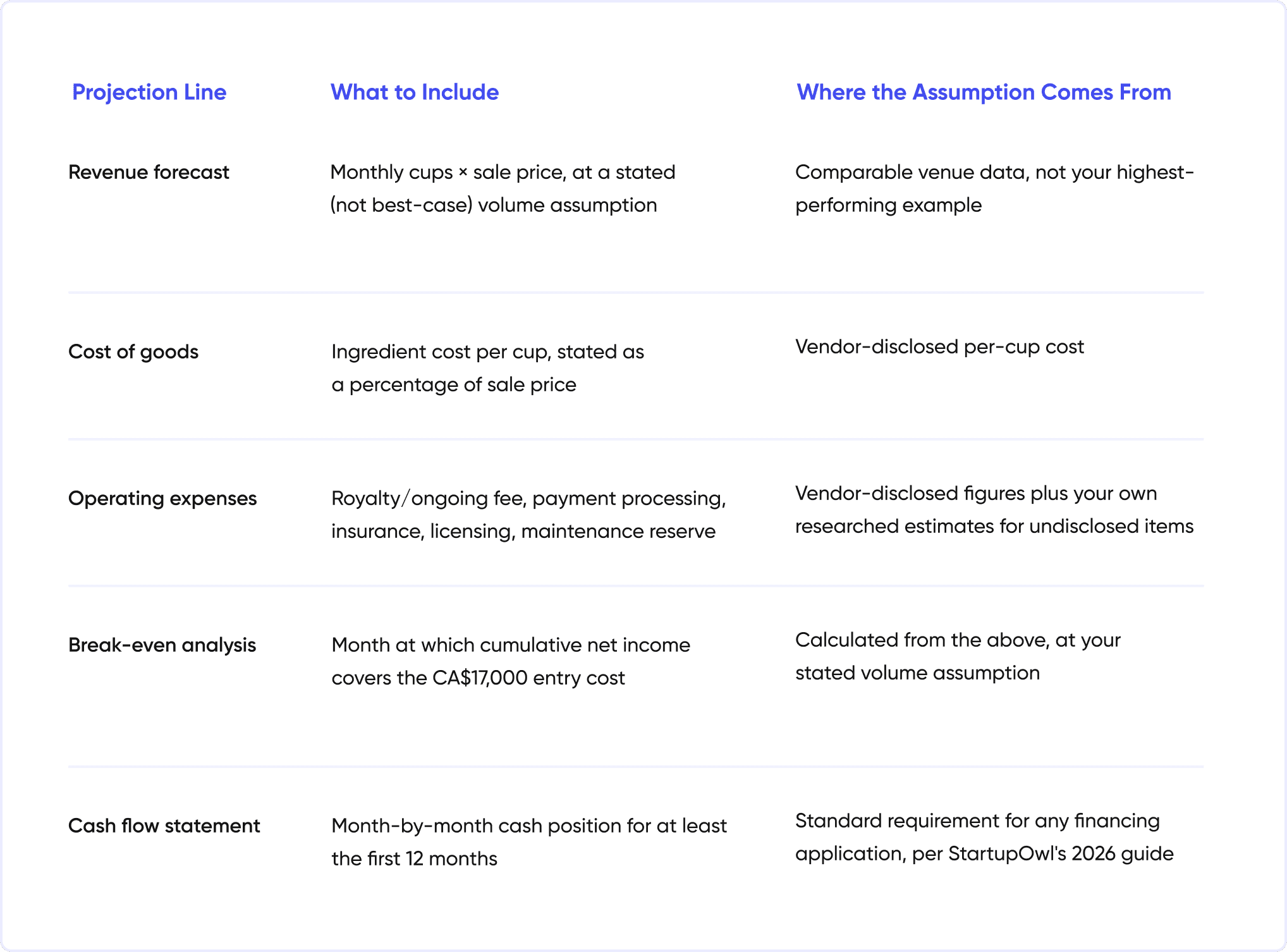
For the financing side of this section specifically, our guide to funding options for a first automated coffee bar walks through what documentation BDC and CSBFP lenders expect alongside this financial model.
6. Management and Ownership
Even for a single-operator business, lenders want to see relevant experience or a credible plan for how you will manage the business, particularly if this is your first venture. If you have no direct food and beverage experience, this section can note the structured onboarding, dashboard tooling, and ongoing support provided as part of the Touch Coffee partner model, which reduces the operational learning curve a lender might otherwise be concerned about.
7. Funding Request (If Applicable)
If you are seeking financing rather than self-funding, state clearly: how much you need, what it will be used for (the unit purchase, initial supplies, any setup costs), and your proposed repayment structure based on the financial projections above. According to the Complete Guide to Business Plan Structure 2026, Canadian lenders, from major banks to BDC, now expect financial projections backed by clearly stated assumptions, not just a requested dollar figure.
How Long Should a Coffee Vending Machine Business Plan Actually Be
For a large venture-backed startup, business plans commonly run 15–25 pages according to MBE for You's 2026 guide. For a single-unit or small-portfolio automated coffee bar business, that level of detail is unnecessary and, in most cases, actively counterproductive; lenders and co-investors skim, and a bloated document signals unclear thinking rather than thoroughness.
A realistic target for a Touch Coffee Smart Bar business plan is 5 to 10 pages, per Startup Project's 2026 template guidance, enough to cover every section above with specific numbers, without padding. If you are applying for financing specifically, check with your chosen lender directly; the CSBFP and BDC both have documentation expectations that may specify a preferred format.
Should You Hire Help to Write the Plan?
According to Custom CPA's 2026 pricing guide, a basic business plan for a single-location small business in Canada typically costs $3,000 to $6,000 when professionally written, while comprehensive plans with CPA-reviewed financial modeling for larger ventures range from $8,000 to $20,000+. For a CA$17,000 investment, paying several thousand dollars for a professionally written plan may not make financial sense.
A more proportional approach for most investors: write the narrative sections yourself using the structure above, and bring in a Canadian accountant specifically for the financial projections section; even a modest engagement for that one section significantly improves the plan's credibility with lenders, per Custom CPA's guidance, without the cost of a full professional writing engagement.
Common Mistakes to Avoid
Overestimating cup volume without evidence. Basing your financial model on your highest-performing comparable location rather than a realistic average is the fastest way to lose credibility with a lender.
Ignoring undisclosed operating costs. A plan that only shows ingredient cost and royalty, with no line for insurance, licensing, or maintenance, will read as incomplete to anyone who has evaluated a similar business before
Vague market research. "Coffee is popular in Canada" is not market analysis. Specific foot traffic data for your target venue is
Missing documented assumptions. Every number should trace back to a source, a vendor-disclosed figure, a comparable venue's performance, or your own researched estimate, clearly labelled as such.
No break-even analysis. Lenders and co-investors want to see the specific month your cumulative cash flow turns positive, not just an eventual profit margin
Get the Numbers to Build Your Plan
A strong business plan for a coffee vending machine business is built on specific, sourced numbers, not general assumptions about the category. If you are researching small business ideas in Ontario or anywhere in Canada and want the underlying data to build your financial projections properly, speak with the Touch Coffee team for the current per-cup economics, venue category performance data, and financing documentation your plan and any lender conversation will need.
Whether you are planning a single unit or a multi-location portfolio from the outset, start that conversation with Touch Coffee today and get the specific figures for your target city before you finalize your plan.