Back

How to Value and Sell an Automated Coffee Business in Canada
A practical guide to valuation, exit planning, buyer expectations, and Canadian tax considerations.
Most investors researching the Touch Coffee Smart Bar opportunity focus entirely on entry cost, payback period, monthly income. Few think about the exit until they already own the asset, which is backwards. Serious investors plan their exit before they plan their entry. This article covers what that planning actually involves: how a small automated coffee bar business gets valued, what buyers look for, how Canadian tax rules can affect what you keep from a sale, and a realistic not idealized timeline for the process.
Why Exit Planning Starts Before You Buy, Not Before You Sell
According to Peninsula Road's 2026 guide to selling a Canadian business, the most successful exits share a common pattern: preparation starts roughly twelve to twenty-four months before the owner is actually ready to sell. That timeline reflects how long it takes to build the qualities that make a business valuable to a buyer: clean financials, documented agreements, and reduced dependence on the current owner do not happen overnight.
For an automated coffee bar business, that means from day one: keeping organized financial records, documenting venue agreement terms clearly, maintaining equipment properly, and tracking performance data consistently. These are also, not coincidentally, the same habits that support running the business well day to day good operating discipline and good exit preparation overlap significantly.
SDE or EBITDA? Which Metric Applies to Your Coffee Bar Business
Small businesses are not all valued using the same earnings metric, and using the wrong one produces a misleading valuation. According to Morgan & Westfield's business valuation knowledge base, Seller's Discretionary Earnings (SDE) defined by the International Business Brokers Association as an owner's total compensation plus normalized business earnings is used for businesses generating under roughly $1 million in earnings, because these businesses are typically sold to an individual buyer who will personally replace the owner's role. EBITDA (earnings before interest, taxes, depreciation, and amortization) becomes the more relevant metric once a business exceeds roughly $1 million in earnings, because at that scale a buyer usually expects to hire a manager rather than operate the business personally.
For a single-unit or small-portfolio automated coffee bar business, SDE is almost always the correct metric not EBITDA. This matters because the two numbers differ meaningfully: SDE adds back the owner's full compensation and personal-use expenses, while EBITDA treats owner compensation as a normal operating cost. According to Midstreet's 2026 business valuation resource, SDE is normally a higher number than EBITDA, since it reflects the full financial benefit an owner receives, not just the business's operating profit.
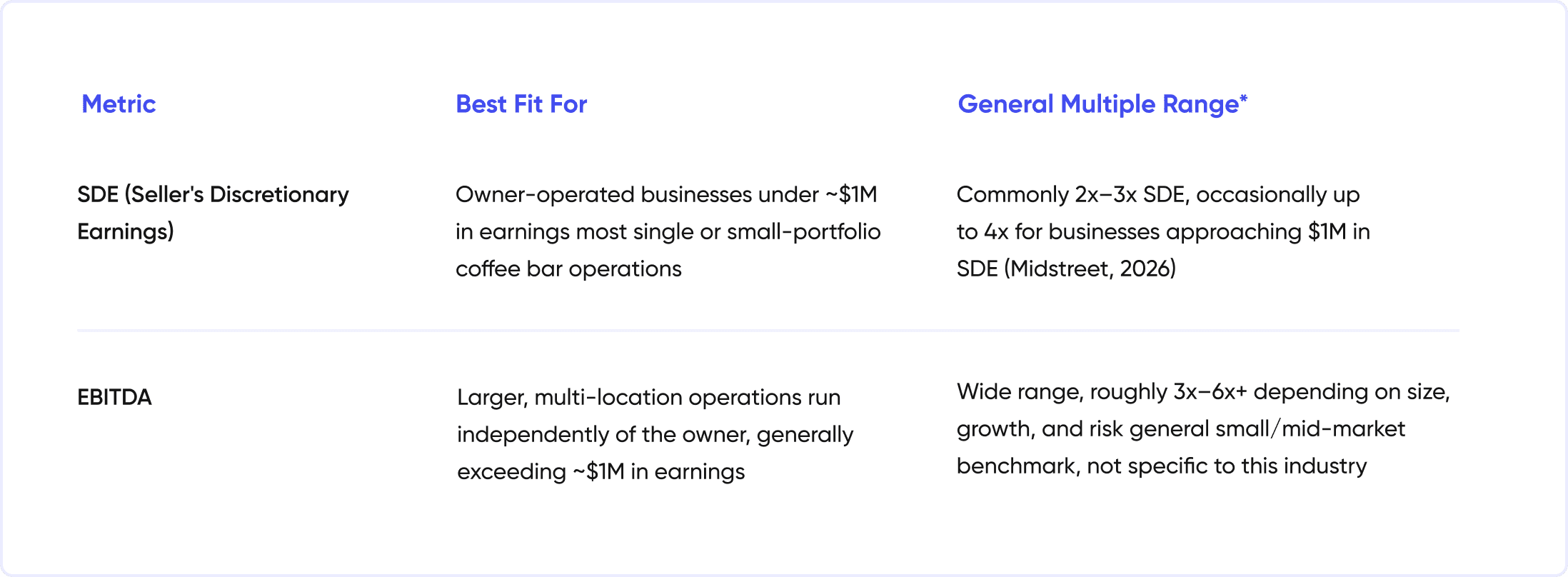
These multiple ranges come from general small-business valuation literature, not from a database of verified automated coffee bar or vending business sales; no such public dataset was available at the time of writing. Treat these as a starting reference point, not a guaranteed outcome. The actual multiple that applies to your business depends heavily on machine age and condition, venue agreement strength and remaining term, revenue concentration across locations, and buyer demand at the time of sale all discussed further below. A Chartered Business Valuator can provide a defensible, business-specific estimate.
What a Buyer Actually Looks For in an Automated Coffee Bar Business
According to DFY Vending's 2025 guide to vending business valuation, buyers generally prioritize three things: profitability, scalability, and operational simplicity. For a coffee vending machine business specifically, this translates into several concrete factors a buyer will assess.
Clean, verifiable financial records: Organized profit and loss statements and consistent revenue history. A buyer who cannot quickly verify your numbers will discount their offer to account for the uncertainty, or decline to proceed
Machine condition and technology currency: Well-maintained equipment with current, functioning cashless payment systems signals proper upkeep. Deferred maintenance is a cost the buyer inherits and will price accordingly
Documented, transferable venue agreements: Covered in detail below this is often the single most important factor in a coffee bar business sale
Reduced and documented owner dependency: A business that depends on the specific personal relationships, knowledge, or presence of the current owner is riskier for a buyer to acquire
Automation Reduces Some Owner Dependency But Not All of It
Automation genuinely reduces one specific category of key-person risk: day-to-day staffing and operational management. Unlike a staffed café, an automated coffee bar does not depend on the current owner to show up and run service; the machine operates independently.
That said, the business can still depend heavily on the current owner in other ways: the personal relationship with the venue contact, unwritten knowledge of the restocking routine and supplier contacts, and informal understanding of the machine's maintenance history. A buyer evaluating the business will discount their offer if the venue relationship appears informal, close to expiry, or not formally assignable to a new owner regardless of how well-automated the machine itself is.
The practical takeaway: automation only translates into a lower-risk, higher-value sale when the operating procedures, supplier relationships, and venue agreement are documented and formally transferable not simply because the machine runs itself day to day.
Why the Venue Agreement May Be the Most Valuable Part of the Business
The placement location is frequently the most valuable single component of a vending or automated coffee bar business, arguably more valuable than the machine itself, since the machine can be replaced but a strong, established location often cannot. A written venue agreement does not automatically increase the business's value, however. What matters to a buyer is the specific commercial content of that agreement.
Remaining term: An agreement with two or three years remaining is worth more to a buyer than one expiring in three months, since the buyer is acquiring the future revenue that term represents
Renewal provisions: Clear, favourable renewal terms reduce the buyer's risk that the location and its revenue disappears shortly after purchase
Assignment rights: The agreement should explicitly permit transfer to a new owner. Without this, the venue may need to separately approve the buyer, adding uncertainty and delay to the sale
Venue approval for transfer: Some institutional venues hospitals, universities, government buildings have formal vendor approval processes that a new owner must pass, independent of the private sale agreement between buyer and seller
Location concentration is a related risk buyers weigh carefully. If a single hospital, university, or corporate office generates most of a business's revenue, a buyer may treat the business as higher risk than the current performance alone suggests because losing that one relationship after the sale would eliminate most of the income. Investors building a multi-unit portfolio across several distinct venues, rather than concentrating in one location, generally present a more resilient and more valuable business to a future buyer for this reason.
The Tax Side of Selling: What the Lifetime Capital Gains Exemption Actually Requires
For Canadian business owners selling through a corporation, the Lifetime Capital Gains Exemption (LCGE) is potentially the largest available tax saving on a business sale. For 2026, several accounting sources cite the LCGE limit at approximately $1.25 million for Qualified Small Business Corporation (QSBC) shares this amount is indexed annually, so confirm the exact current figure directly with the CRA or a CPA rather than relying on any single published article, including this one.
The LCGE only applies to QSBC shares specifically not to every business sale, and not automatically to every Canadian-Controlled Private Corporation (CCPC). According to guidance summarized by ThinkAccounting, Insight Accounting CPA, and CPABC's technical publication on QSBC shares, qualifying generally requires meeting several distinct tests:
CCPC status: The corporation must be a Canadian-Controlled Private Corporation, maintained continuously
Holding period test (24 months): The shares generally must have been owned by the individual (or a related person) for the 24 months immediately before the sale
Active asset test during the 24-month period: Throughout that same 24 months, more than 50% of the fair market value of the corporation's assets must have been used in an active business carried on primarily in Canada
Small Business Corporation (SBC) test at the time of sale: At the moment of disposition, generally 90% or more of the corporation's assets must be used in an active business
Individual resident requirement: The LCGE is claimed by an individual who is a Canadian resident it is a personal exemption, not a corporate one
A business can be a perfectly healthy, profitable operation and still fail these tests for example, if it has accumulated significant cash or investment holdings beyond what the active business needs, that can push the corporation offside on the asset tests. Because the tests look backward over a 24-month window, this is not something that can typically be fixed with a last-minute adjustment before a sale.
This is also where the asset sale versusshare saledecision becomes directly relevant: the LCGE is only available on a share sale, not an asset sale. According to Xero Canada's 2026 guide, buyers often prefer asset sales because they can select specific assets and avoid inheriting unknown liabilities, while sellers often prefer share sales specifically to access the LCGE. For a single-unit coffee bar business, the dollar amounts involved may be modest enough that this distinction matters less but for an investor who has built a multi-unit portfolio over several years, the sale structure can meaningfully affect the after-tax outcome.
Given the technical nature of these rules and the fact that qualification depends on your complete financial picture, this is genuinely a conversation for a CPA, Chartered Business Valuator, or tax lawyer, not something to finalize based on general guidance alone, including this article.
A Worked Example: Valuing a Three-Machine Coffee Bar Portfolio
Abstract percentages are easier to understand with real numbers attached. The following is an illustrative, hypothetical example not a real transaction showing how SDE-based valuation might work for a small portfolio.
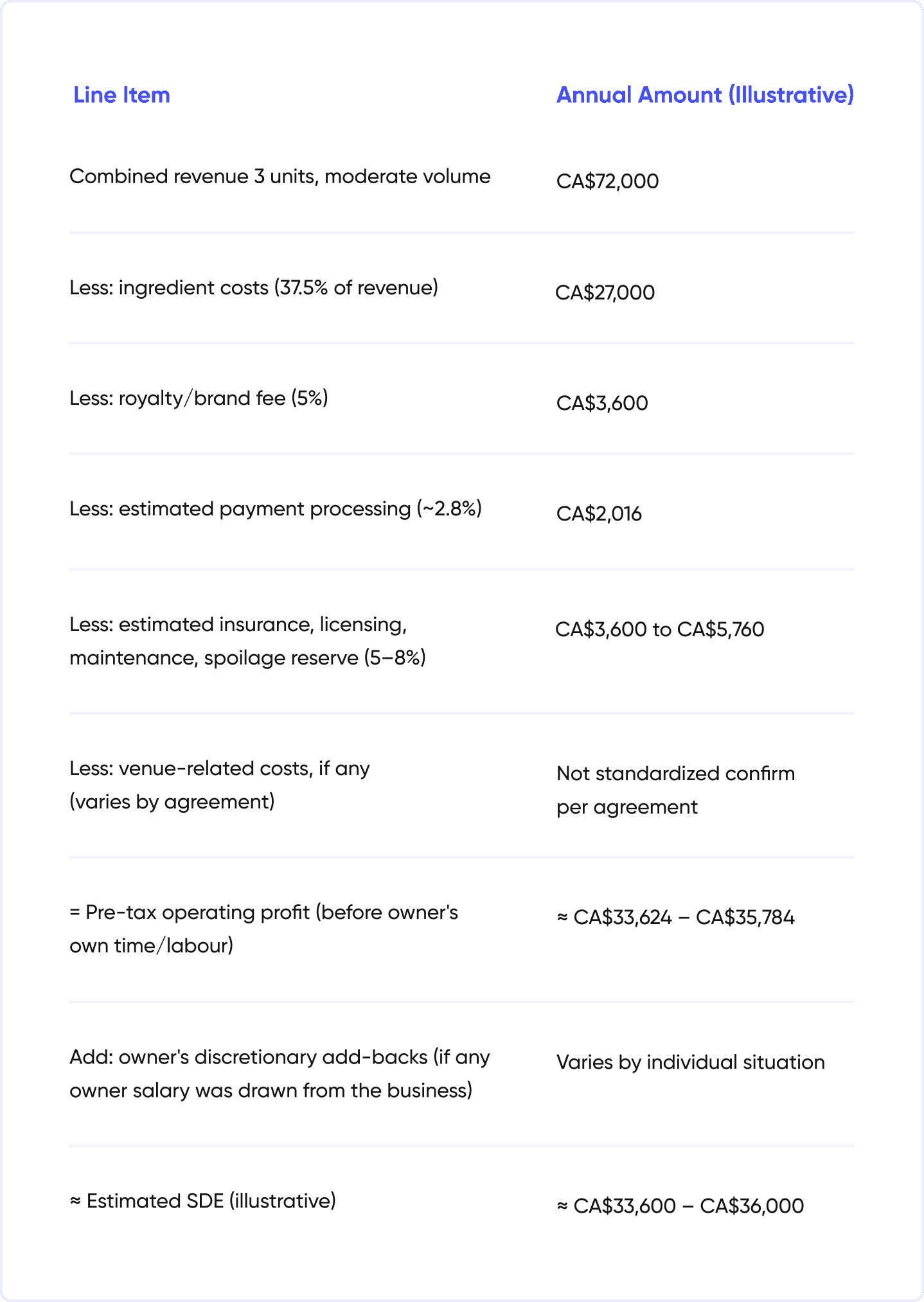
Applying the general SDE multiple range discussed earlier commonly 2x to 3x for owner-operated small businesses this illustrative three-unit portfolio might value in a broad range of roughly CA$67,000 to CA$108,000 on an earnings basis, before accounting for the specific strength of the venue agreements, machine age, and location concentration discussed above. That figure should also be checked against an asset-based valuation the depreciated resale value of three physical Smart Bar units, plus any remaining useful life since a buyer will generally not pay more for the earnings stream than the underlying assets would cost to simply replace, and a seller should not accept less than the assets are independently worth. Where the earnings-based and asset-based figures diverge significantly, that gap is exactly the kind of thing a Chartered Business Valuator is engaged to resolve.
The point of this example is not the specific dollar figures every real business will differ but the process: revenue alone does not determine sale price. A buyer is purchasing transferable future cash flow, and every deduction above represents a real cost that reduces what that cash flow is actually worth.
An Illustrative Exit Timeline Not a Guaranteed Schedule
The stages below are drawn from general Canadian small business sale guidance and represent a typical sequence of steps, not a predictable or guaranteed schedule. In practice, a sale can take considerably longer due to buyer financing delays, legal negotiation, equipment inspection findings, venue consent requirements, valuation disagreements, or tax planning that requires restructuring well in advance of the sale.
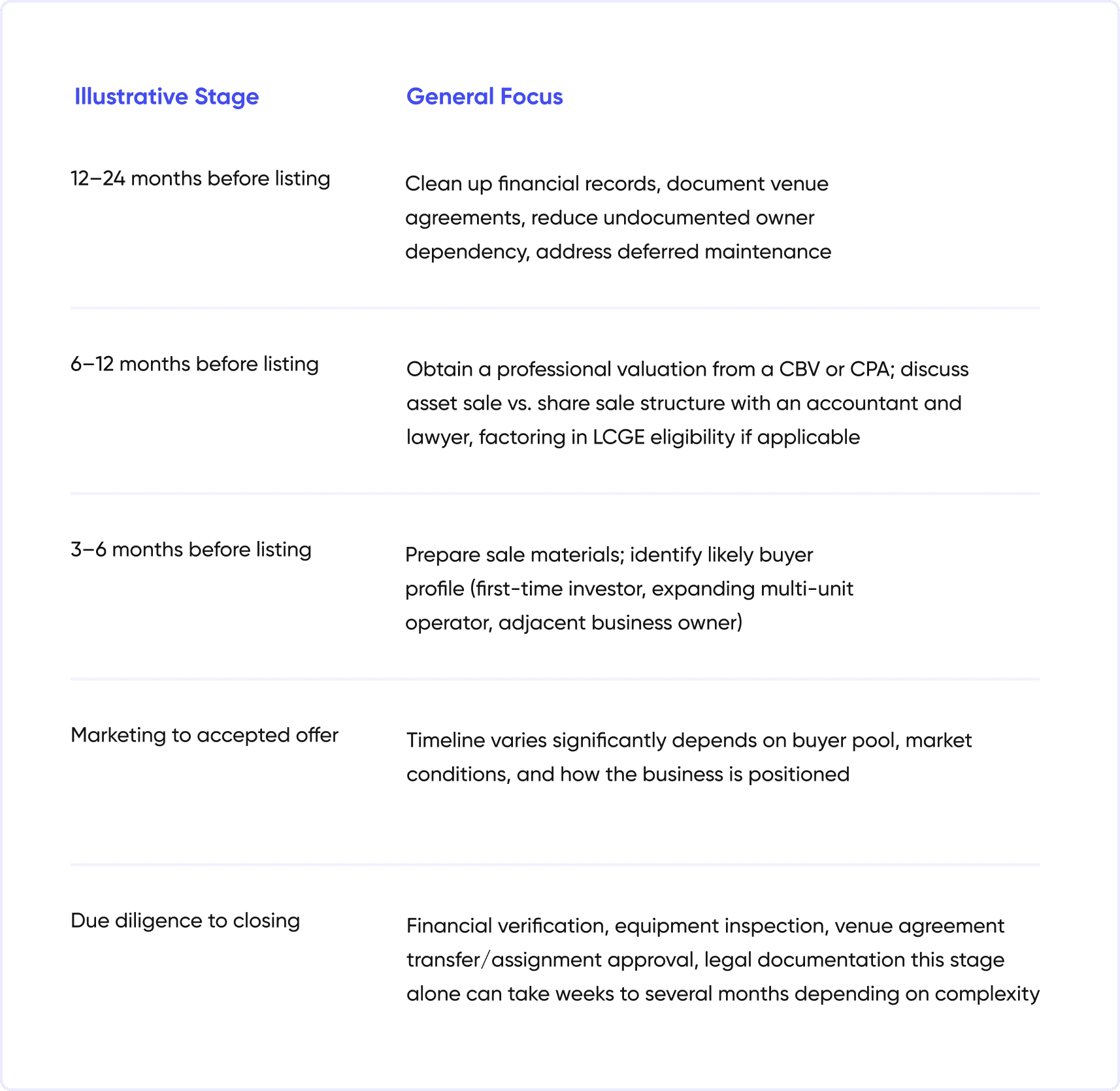
Deal structures also vary. Beyond a straightforward asset or share sale, transactions sometimes include seller financing (the seller accepts payments over time rather than a lump sum), a holdback (a portion of the price withheld pending post-sale performance or issue resolution), an earn-out (additional payment contingent on the business hitting agreed targets after the sale), or a negotiated transition-support period where the seller assists the buyer for a defined time after closing. Which structure applies depends on negotiation between the parties and should be discussed with legal counsel.
Practical Steps That Tend to Support a Stronger Valuation
A few consistent practices, applied throughout ownership rather than assembled at the last minute, tend to matter most:
Keep detailed performance records from day one. Monthly cups sold, revenue, and any location changes form the historical performance record a buyer or valuator will request the kind of documentation that is far easier to maintain continuously than to reconstruct after the fact
Maintain equipment proactively, not reactively. A documented maintenance history supports buyer confidence more than an unclear service record
Formalize the venue relationship in writing. A clear agreement with assignment rights, ideally with meaningful time remaining, is worth more to a buyer than an informal arrangement even a strong one
Consider timing relative to venue agreement renewals. Selling shortly after securing a fresh multi-year term is generally viewed more favourably than selling close to an uncertain renewal date
If operating multiple units, keep records separated by location. A buyer may want the full portfolio or only the strongest-performing locations organized, location-specific records support either outcome
Touch Coffee partners have access to the performance dashboard used for day-to-day monitoring, which according to Touch Coffee can also serve as a historical performance record over time. As with all figures in this article, the specific reporting features and their suitability for valuation purposes should be confirmed directly with the Touch Coffee team and, where relevant, your own accountant.
Who Typically Buys an Automated Coffee Bar Business
Understanding your likely buyer pool shapes how you prepare. Based on general patterns in the unattended retail resale market, buyers tend to fall into a few broad categories:
First-time investors entering the category looking for an established, revenue-proven unit rather than starting from an unproven location
Existing multi-unit operators expanding their portfolio often able to move through due diligence efficiently since they already understand the operating model
Adjacent business owners diversifying for example, the owner of a nearby business who sees value in acquiring a unit already placed in a location they understand
Each buyer type weighs different factors; a first-time buyer is more sensitive to documentation and perceived risk, while an experienced operator focuses more heavily on the underlying numbers and venue agreement terms.
Plan Your Exit From Day One, Not Just Your Entry
According to Touch Coffee, the partners best positioned for a strong eventual exit are the ones who treat documentation, maintenance, and venue relationship management as ongoing priorities from the start, not tasks to complete when a sale is already in motion.
If you are evaluating the vending machine business or small business ideas category and want to understand what a well-documented entry looks like, speak with the Touch Coffee team about the partner dashboard and support infrastructure available from day one of ownership.
If you are already a Touch Coffee partner starting to think about your own exit timeline, reach out to our team we can point you toward the performance data that will matter most, and we'd encourage you to pair that with guidance from a CPA, CBV, or tax lawyer for the parts of this decision that are specific to your situation.