Back

Corporate Cafeterias & Transit Hubs: The Next Frontier for Automated Coffee Bar Placements
Why these high-traffic venues are emerging as strong new location opportunities.
Hospitals, campuses, gyms, hotels, and malls are the established venue categories in the Touch Coffee network, each with years of operational data behind it. But two venue types are increasingly coming up in conversations with investors and venue operators alike, corporate cafeterias inside larger office complexes, and transit hubs, and they represent a genuinely early-stage opportunity within the broader automated coffee bar category.
This article covers why these two venue types are worth an investor’s attention now, what makes them structurally different from the venue categories already well established in the network, and what an early mover should understand before approaching one.
Why Corporate Cafeterias Are a Distinct Opportunity From General Office Placements
Our guide to office environments covers the strong case for placing a Smart Bar in a standard corporate office setting, captive daytime population, predictable peak windows, minimal space requirement. A corporate cafeteria, inside a larger office complex or corporate campus, is a related but distinct opportunity worth separating out.
Cafeterias in large office complexes already function as a designated food-and-beverage destination, employees are already in the habit of walking to that specific location during breaks, which removes one of the adoption hurdles a standalone office kiosk placement has to overcome, teaching employees a new routine. A cafeteria placement benefits from foot traffic that’s already self-selected for food and beverage purchases, rather than needing to intercept people at their desks or in a hallway.
Large corporate campuses with multiple buildings and a centralized cafeteria facility also offer a meaningful scale advantage: a single strong cafeteria placement can serve an employee population equivalent to several standalone office placements combined, without the management overhead of negotiating multiple individual building agreements.
Why Transit Hubs Are Gaining Investor Attention
Transit hubs, train stations, major bus terminals, and similar high-throughput transportation venues, represent a different demand profile entirely from an office or campus: extremely high daily foot traffic, but with each individual passing through only once or twice rather than returning multiple times a day the way office or campus populations do.
What makes transit hubs compelling is sheer volume. A high-traffic terminal can see foot traffic that dwarfs even a strong shopping mall placement, and unlike a mall, that traffic includes a large proportion of commuters on a genuinely time-pressured schedule, exactly the audience most likely to value a fast, contactless, self-service coffee purchase over waiting in a staffed line.
Transit hub placements also tend to have longer operating-hour requirements than most other venue categories, often extending into early morning and late evening to match transit schedules, which plays directly to the Smart Bar’s around-the-clock automated operation with no staffing cost implications for the extended hours.
Why These Are “Early Mover” Opportunities Right Now
Both venue types share a characteristic that matters specifically for investors thinking about long-term positioning: they are less saturated with existing automated coffee options than well-established categories like malls and campuses, where competition for the best individual locations has increased as the category has matured.
This mirrors the broader market pattern already playing out in the automated coffee bar sector, early movers into an emerging venue category establish relationships, positioning, and often more favourable terms than investors entering after a category becomes contested. Investors who secured strong hospital and campus placements early in the Touch Coffee network’s growth are now operating from a position that would be harder to replicate today, simply because the strongest individual locations within those categories are increasingly already placed. Corporate cafeterias and transit hubs are, structurally, where hospitals and campuses were several years ago.
What to Understand Before Approaching Either Venue Type
Both categories differ from the venue types covered in our existing placement guides in ways worth planning for.
Decision-Maker Complexity A corporate cafeteria inside a large office complex is often managed by a facilities or corporate services team distinct from the department that would approve a standalone office kiosk, worth confirming who actually owns cafeteria vendor decisions before starting the conversation. Transit hubs are frequently managed by a transit authority, municipal body, or a private facilities operator under contract, a more formal, often longer approval process than a private business, similar in structure to the hospital approval process covered in our hospital placement guide.
Space and Installation Considerations Cafeteria placements typically have straightforward power access given the existing food-service infrastructure. Transit hub placements can vary significantly, some stations have dedicated retail zones with standard power access, while others may require additional coordination around security, public-space regulations, and facility-specific installation standards.
Revenue Predictability Cafeteria placements, benefiting from an already-captive, returning population, tend to offer revenue predictability closer to a standard office or campus placement. Transit hub placements can see more variability tied to commuter patterns, weekday versus weekend schedules, and seasonal travel fluctuations, worth factoring into a conservative financial projection rather than assuming mall-level or campus-level consistency from day one.
Is a Cafeteria or Transit Hub the Right Next Placement for You?
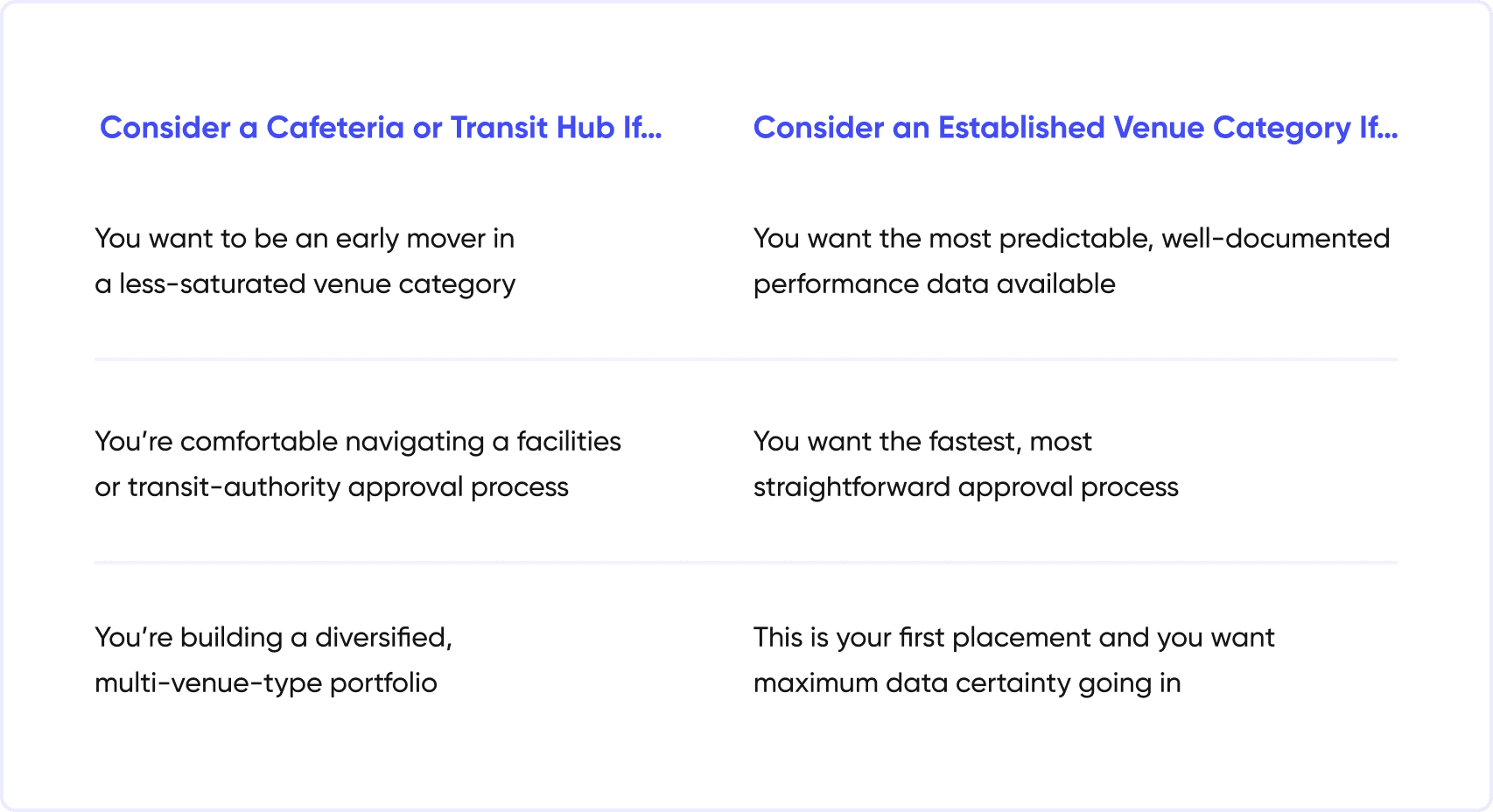
Corporate cafeterias and transit hubs represent the kind of positioning opportunity that becomes harder to access as more investors recognize it, the same pattern that played out in hospitals and campuses. If you’re interested in evaluating a specific cafeteria or transit venue, or want to understand how this fits into a broader placement strategy, contact the Touch Coffee team directly.
Thinking about an early-mover placement? Start the conversation with Touch Coffee today and find out what’s realistic for the venue you have in mind.