Back
Best Semi-Passive Income Franchise Opportunities USA
Explore the best semi-passive income franchise opportunities in the USA for 2026. Low-labor automation models with strong US franchise ROI in food tech and unattended retail.
The US franchise industry remains a cornerstone of economic stability and opportunity. According to the International Franchise Association's 2026 Franchising Economic Outlook, franchised businesses are projected to generate over $921.4 billion in economic output in 2026 (up 1.6% from $907.3 billion in 2025), operate approximately 845,000 establishments (a 1.5% increase), and employ nearly 8.9 million people. This steady expansion - despite cautious consumer spending - highlights the resilience of franchise models, particularly those that minimize labor dependency and offer repeatable scalability.
For serious investors seeking semi-passive income franchise opportunities in the USA, low-labor automation models stand out in 2026. These ventures leverage food tech and unattended retail systems to deliver strong US franchise ROI with minimal daily involvement. From our extensive experience advising partners across major US markets, we consistently see these technology-driven concepts outperform traditional staffed franchises in time freedom, margin consistency, and multi-unit growth potential.
This post focuses on why automation-based franchises are among the best semi-passive income options right now, key performance drivers, realistic expectations, and how qualified investors can evaluate them effectively.
Low Labor Businesses: The Core Appeal in 2026
Low labor businesses eliminate the single largest variable cost and operational headache in most franchises: staffing. In traditional food & beverage concepts, labor often consumes 30–50% of revenue through wages, training, scheduling, turnover, and compliance. Automated models reduce this exposure to near zero, typically requiring only 20–30 minutes per day for basic restocking and remote monitoring via app.
In 2026, labor shortages and rising wage pressures continue to favor automation. The intelligent vending machine segment alone is forecasted to reach $17.7 billion in 2026 and grow to $53.2 billion by 2036 at an 11.6% CAGR, driven by demand for reliable, unattended solutions in offices, hospitals, universities, airports, gyms, and transit hubs. Partners we have supported frequently achieve 40–50% gross margins per unit once placed in high-traffic venues - far exceeding many conventional franchises after labor is deducted.
If low labor businesses align with your investment priorities, explore how Touch Coffee structures these opportunities.
Automation Models Delivering Semi-Passive Income
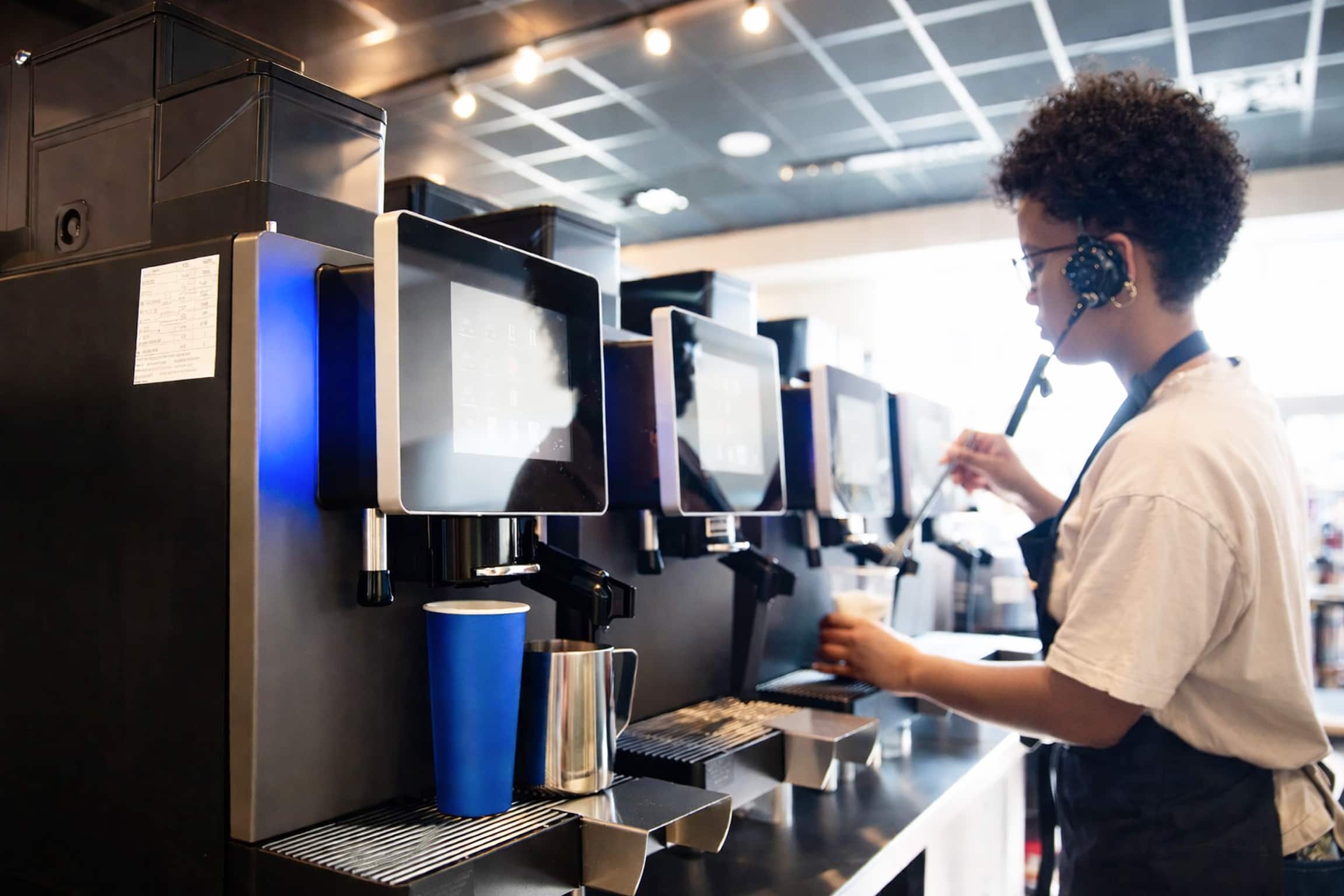
Automation models excel at creating semi-passive income because the technology itself becomes the primary workforce. Proprietary smart kiosks handle order taking, precise brewing (bean-to-cup with professional-grade components), payment processing (contactless/NFC/cashless), and even basic cleaning cycles. Owners receive real-time sales data, inventory alerts, and performance dashboards remotely.
Realistic performance in strong US locations includes:
Average cup price ≈ $4.00
Cost per cup (supplies + service fee) ≈ $1.00–$1.20
Net profit per cup ≈ $2.80–$3.00
At 70–100 cups/day → $6,300–$9,000 monthly net per unit
Many partners see full investment recovery in 5–9 months in optimal placements, with ongoing net returns of 15–40% annually on invested capital thereafter. One multi-unit operator we advised expanded from one kiosk in a Phoenix medical center to four units across Arizona and Texas within 18 months - all managed with less than 5 hours weekly total involvement.
For a deeper look at automation models built for semi-passive ownership, review the dedicated US franchise overview.
US Franchise ROI: What Realistic Returns Look Like
US franchise ROI remains attractive in low-labor segments. Startup costs for quality automated concepts typically range from $13,000–$20,000 (far below the $200,000+ common in staffed food franchises), with transparent ongoing fees (often around a 5% service fee - no marketing fund or high fixed costs).
When placed correctly, these units frequently deliver:
Cash-on-cash returns of 38–70% in year one (financed scenarios)
Payback periods of 5–12 months in Tier-1 metro areas
Multi-unit scaling that compounds returns without a proportional time increase
The Southeast and Southwest regions are expected to lead franchise expansion in 2026 (growth rates of 1.7% and 2.5% respectively), fueled by population inflows, business-friendly policies, and lower cost of living - ideal conditions for unattended retail placements in growing cities like Phoenix, Austin, Dallas-Fort Worth, Atlanta, Miami, and Denver.
To better understand potential US franchise ROI, use the profit calculator and see real projections.
Food Automation & Tech Franchises Leading the Semi-Passive Trend
Food automation continues to accelerate in the US, with robotic barista systems, smart kiosks, and micro-market formats gaining traction in high-traffic environments. These tech franchises offer repeatability: the same compact, plug-and-play unit performs consistently whether in Los Angeles, Chicago, New York City, Seattle, or Houston.
Micro markets (a related unattended format) generate significantly higher spend per transaction than traditional vending, while cashless systems continue to lift average tickets. Investors benefit from centralized oversight - multiple units in different states can be monitored from one dashboard, making national or regional scaling realistic and low-effort.
For more on how food automation creates scalable semi-passive income, read our detailed guide on automated food & beverage franchises.
Strategic Placement: The Key to Strong Performance
Placement drives success more than any other factor in unattended retail franchises. High-foot-traffic commercial venues - hospitals, universities/colleges, large office buildings, airports, hotels, fitness centers, and transit hubs - deliver the volume needed for optimal returns.
Unlike traditional retail franchises that rely on consumer walk-in traffic, these models thrive where captive audiences already exist and value convenience over ambiance. Strategic location scouting (often supported by the operating platform or partner network) is therefore one of the highest-leverage activities for maximizing US franchise ROI.
To learn which US locations offer the strongest potential right now, see our guide on the best locations for smart coffee bars.
Why Touch Coffee Stands Out Among Semi-Passive Options
Touch Coffee provides one of the most investor-aligned automated smart coffee bar business models available in the US market today. The dedicated US platform at Touch Coffee offers full transparency on models (Standard & Premium), transparent economics, remote telemetry features, and proven placement examples.
With a low entry point (~$13,000–$20,000 depending on financing), no partner fee, a transparent 5% service fee, and comprehensive support - including location guidance and technical assistance - Touch Coffee is purpose-built for semi-passive ownership in high-traffic commercial environments. Recognized for technology excellence and backed by real-world results, it continues to attract serious US investors looking for repeatable, low-labor growth.
For the complete US franchise details and to evaluate fit, visit Touch Coffee directly.
Frequently Asked Questions
What qualifies a franchise as semi-passive in the US?
Minimal daily time commitment (under 1 hour/day average), remote oversight via app, no on-site staffing, and recurring revenue from high-traffic placements.
How does US franchise ROI compare to traditional models?
Automated concepts often achieve 38–70% cash-on-cash returns and 5–12 month payback in good locations - significantly faster and more predictable than staffed franchises.
Are these opportunities suitable for multi-state expansion?
Yes - centralized monitoring and repeatable unit economics support regional or national scaling with low added effort.
What support is available for partners in the US?
Full training, supply chain integration, technical/remote support, and location assistance tailored to major US metros.
Semi-passive income franchise opportunities in the USA - especially those powered by automation and unattended retail - are among the strongest plays for serious investors in 2026. With the franchise sector projected to exceed $921 billion in output and low-labor models addressing persistent industry challenges, now is an opportune time to evaluate options that deliver time freedom alongside attractive returns.
If you are a qualified investor ready to explore scalable, low-labor franchises in the United States, we encourage you to take the next step.