Back

Automated Coffee Bar vs. Rental Property: Comparing Two Semi-Passive Investment Paths
Comparing a coffee vending machine business to a rental property? See entry cost, time commitment, and return comparisons side by side before you decide.
Rental property is the default answer most people give when asked how to build semi-passive income. It’s familiar, well understood, and has decades of conventional wisdom behind it. But it’s not the only path, and for a growing number of investors, it isn’t even the most accessible one.
This article puts a Touch Coffee Smart Bar and a self-managed rental property side by side, entry cost, time commitment, risk profile, and return, so investors evaluating small business ideas in Canada can compare the two honestly rather than defaulting to the familiar option.
Entry Cost: A Meaningful Starting Difference
The most immediate difference between the two investments is capital required to get started.
A residential rental property in most Canadian markets requires a down payment in the tens or hundreds of thousands of dollars, plus closing costs, potential renovation costs, and a mortgage qualification process tied to the investor’s personal income and credit profile. A Touch Coffee Smart Bar has a defined entry cost of CA$17,000, transparent, with no financing qualification tied to real estate lending criteria, and, as covered in our financing guide, accessible through CSBFP, BDC, or equipment financing for investors who don’t want to pay entirely in cash.
For an investor without six figures in available capital or the credit profile for an investment mortgage, this difference alone can be the deciding factor between being able to start now versus needing years to save toward a down payment.
Time Commitment: What “Semi-Passive” Actually Means for Each
Both investments are commonly described as semi-passive, but the daily and ongoing time commitment looks different in practice.

A self-managed rental property’s time commitment is uneven, long stretches of minimal involvement punctuated by intensive periods during a tenant turnover, a maintenance emergency, or a vacancy. A Smart Bar’s time commitment is more consistent week to week, restocking on a predictable schedule, with the automated systems, covered in our guide to daily operations, handling payments, cleaning cycles, and temperature control without owner involvement.
Neither is entirely hands-off. But the rental property’s “quiet periods” are frequently interrupted by demands that can’t be scheduled around, a burst pipe or a tenant dispute doesn’t wait for a convenient week, while a Smart Bar’s maintenance alerts are the exception rather than the operational norm.
Return Profile: Payback Period and Ongoing Yield
The two investments generate returns in fundamentally different ways, one through appreciation plus rental yield, the other through direct monthly cash flow from day one.
A Touch Coffee Smart Bar has a payback period of approximately five months at moderate volume (50 cups/day), with net profit of roughly CA$2.50 per cup flowing directly to the owner monthly from the point of installation. There’s no appreciation component, the return is entirely operational cash flow.
A rental property’s return blends two components: rental yield (typically a smaller percentage of property value annually, after mortgage, taxes, insurance, and maintenance) and property appreciation over time, which is not guaranteed and varies significantly by market and timing. Rental property investors are often underwater on pure cash flow in the early years of ownership, particularly with a mortgage, and are relying on appreciation and equity paydown for the larger share of long-term return.
For an investor prioritizing near-term cash flow over long-term equity building, the comparison favours the coffee bar model. For an investor specifically seeking real estate equity exposure as part of a broader portfolio strategy, a rental property serves a different purpose that a Smart Bar isn’t designed to replace.
Risk Profile: Different Categories of Risk
Both investments carry real risk, but the categories are different, and worth understanding on their own terms rather than assuming one is simply “safer.”
A rental property carries tenant risk (non-payment, property damage, difficult evictions), market risk (property values can decline), and concentration risk (a single property represents a large share of most investors’ net worth). It also carries genuine leverage, a mortgage amplifies both gains and losses.
A Smart Bar carries the risks detailed in our full risk breakdown, machine downtime, location dependency on a single venue, and demand variability, but at a substantially lower capital base, meaning the absolute dollar exposure to any single point of failure is smaller. A Smart Bar placement is also location-concentrated, similar in structure to a single rental property being tenant-concentrated, which is why investors in both categories are advised to diversify, additional units in different venues for a coffee bar investor, additional properties or asset
Scalability: Adding a Second Unit vs. a Second Property
This is where the two paths diverge most clearly. As covered in our guide to building a multi-unit portfolio, adding a second Smart Bar does not multiply management complexity the way a second physical rental property typically does, no second mortgage qualification, no second maintenance relationship to build from scratch, and the same ~20-minute daily structure applies per unit regardless of how many are in the portfolio.
A second rental property, by contrast, generally requires a second mortgage application (subject to debt-service ratio limits that constrain how many properties an individual investor can finance), a second tenant relationship to manage, and, if self-managed, a doubling of the time-sensitive demands described above.
Which Investment Fits Which Investor
Neither investment is objectively better, they serve different financial situations and goals.
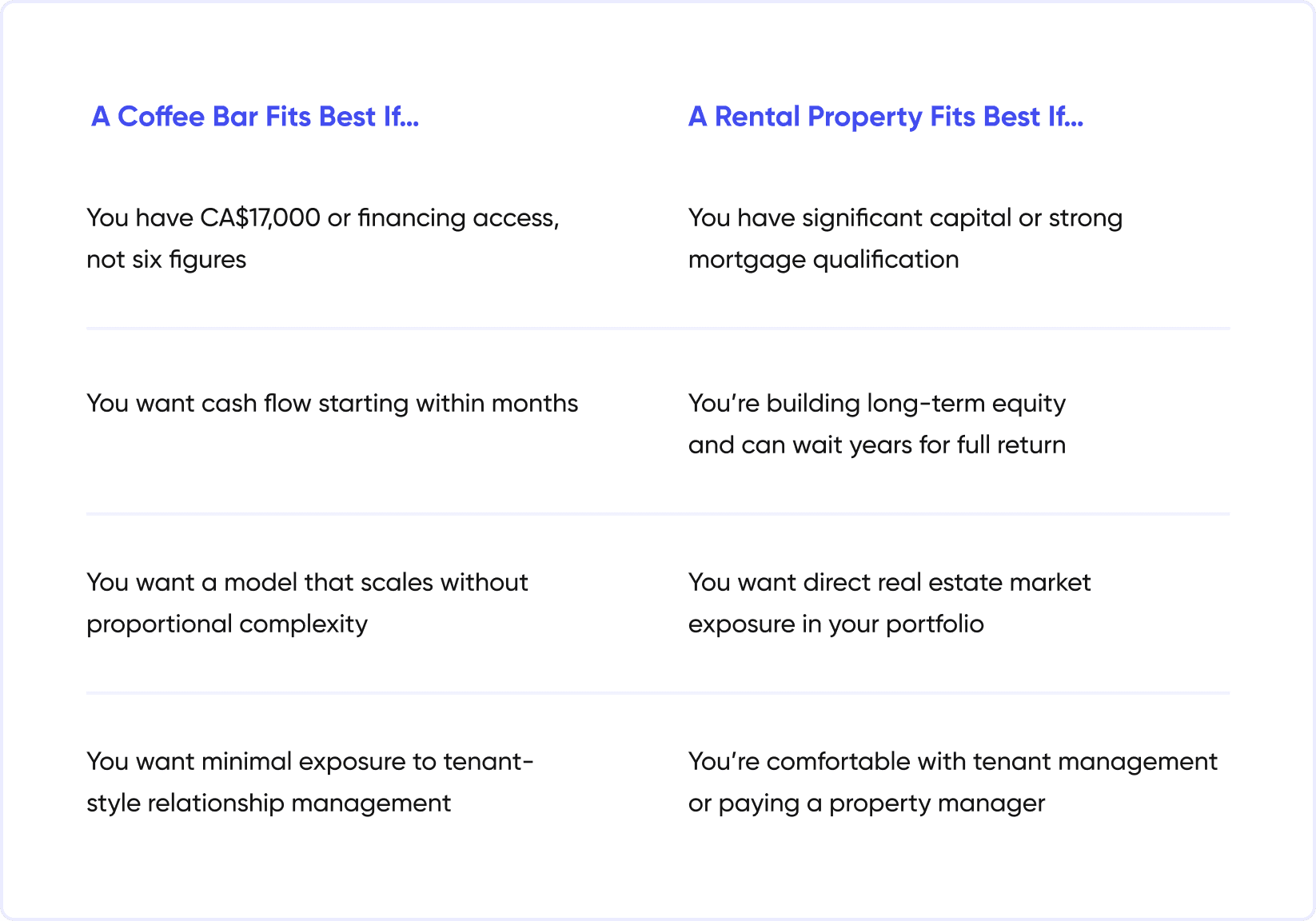
For many investors, the two aren’t mutually exclusive, a Smart Bar’s faster payback and lower entry cost can serve as a stepping stone that builds the capital and confidence for a future real estate investment, rather than competing with it directly.
Compare the Numbers for Your Own Situation
The right comparison depends on your specific capital position, timeline, and risk tolerance, general guidance only goes so far. If you want to work through the real numbers for a Touch Coffee Smart Bar against your own investment alternatives, contact the Touch Coffee team directly.
Weighing your options? Start the conversation with Touch Coffee today and get the specific figures to compare against whatever else is on your list.